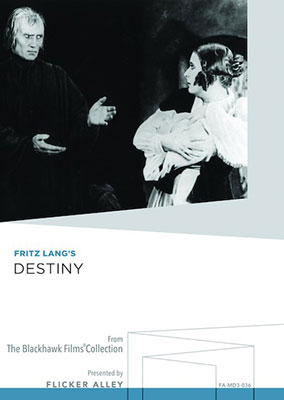
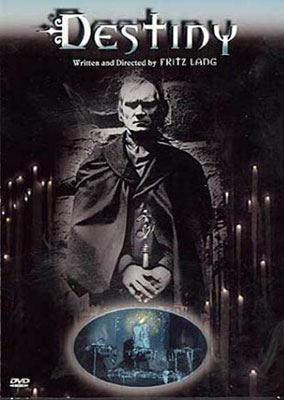
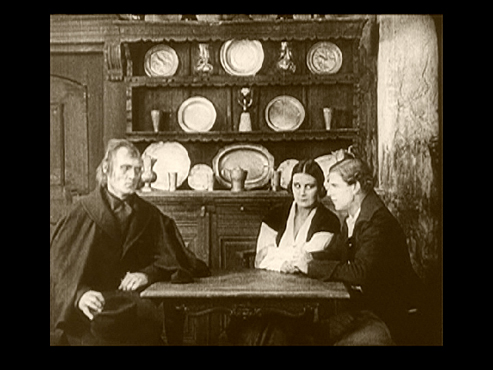
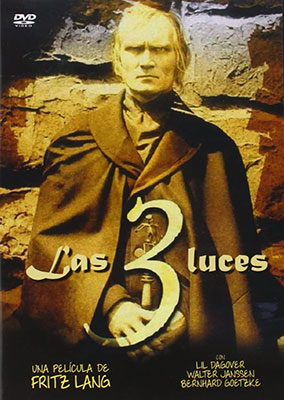
The structure of the film includes the main story involving a young couple and Death in historical Germany, plus three other sections: Arabic, Italian and Chinese. A young couple stops their travels in a small hamlet. There they encounter Death, who takes the young fiance one evening. Death has built a huge walled-in area in the town and the fiancée witnesses the entry of ghost souls, including her fiance, into Death’s wall. She drinks poison to follow her beloved into the wall. But Death is not villainous. Death gives the young fiancée three opportunities — three lives represented by three candles — to save to spare her lover’s life.
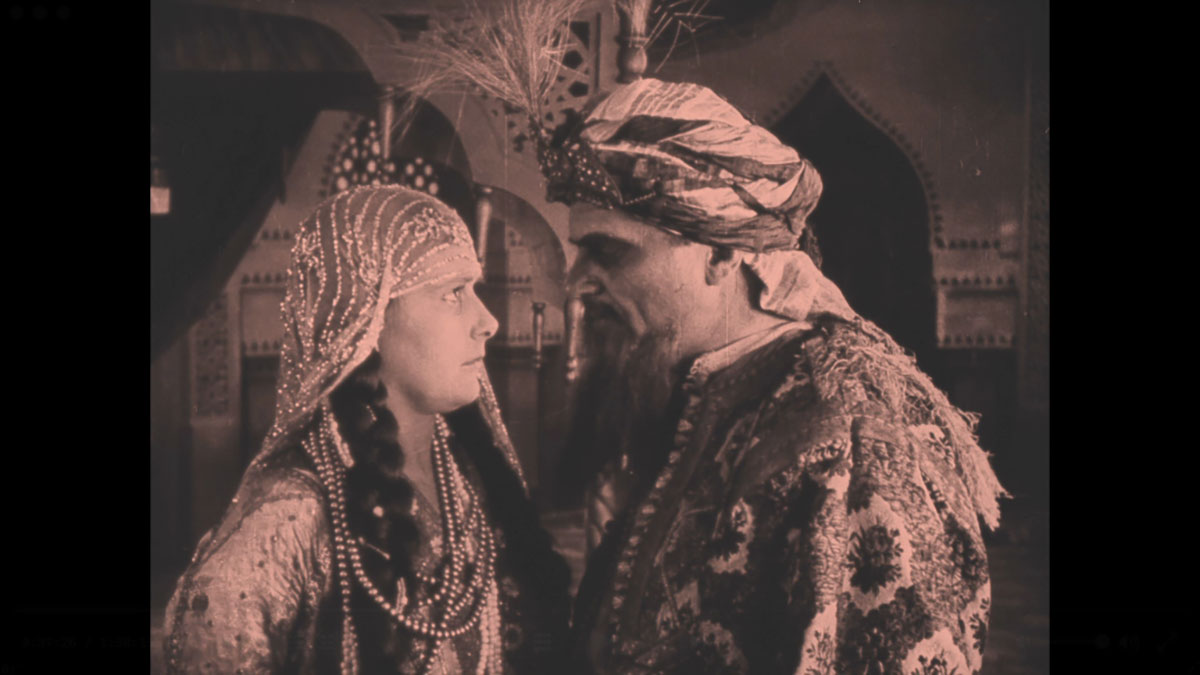
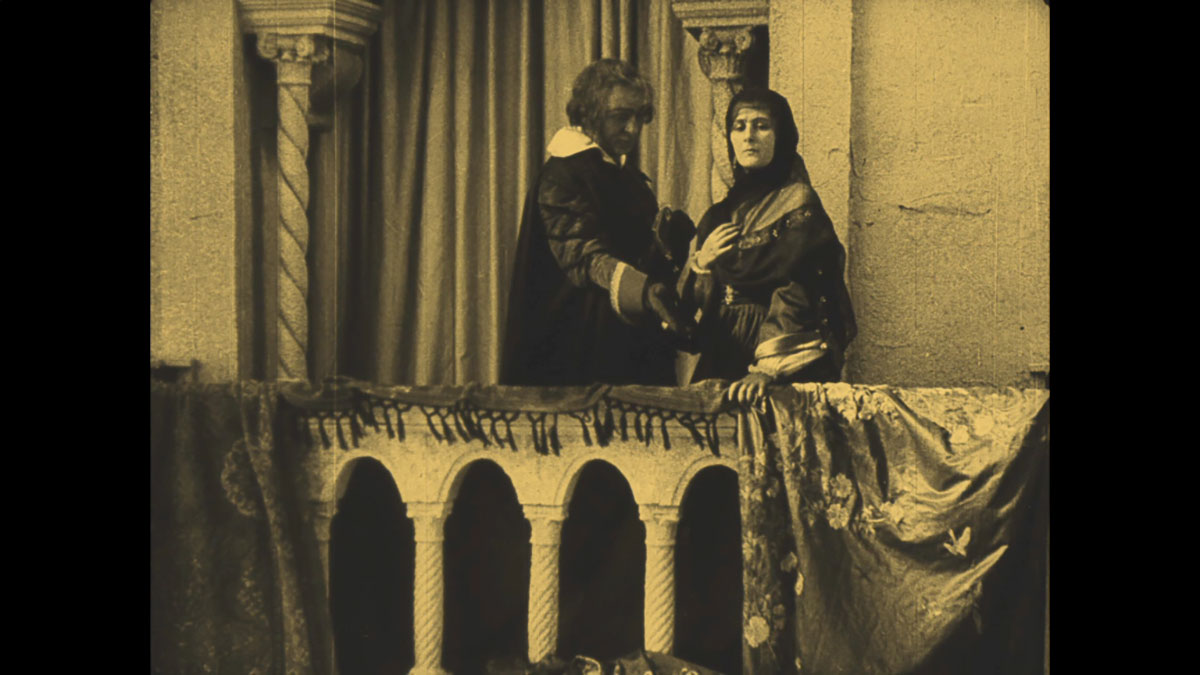
The first story takes place in a Moslem country. A caucasian unbeliever enters a mosque during Ramadan looking for his secret love, the caliph. He escapes. The caliph demands the infidel’s blood. She arranges to bring him into the Palace to safeguard him. The second story is Italian, with well-known character actor Rudolf Klein-Rogge. A woman is betrothed to a man she despises. Her lover is targeted for death. A messenger is assassinated with her entreaty to him to flee. Meanwhile, she hatches a plot to murder her tormentor. The third story is Chinese. The emperor demands a magician for his birthday celebration. The magician has two assistants who secretly smooch. The emperor takes a fancy to the girl, and refuses to accept otherwise. The couple try to flee. He is to be beheaded. She manages to use the magician’s magic wand. They flee together. The story returns to the Germanic era. Has she saved her beloved?
The flying carpet effect in the Chinese story was among the reasons Douglas Fairbanks bought the US rights to this film to suppress its distribution until he could study and incorporate its special effects into The Thief of Bagdad (1924).
The film is stylishly designed and directed. We love Death’s large mysterious wall and the set design of the Arabic and Chinese stories. Lil Dagover, herself, is lovely. And Bernhard Goetzke makes a stern and brooding Death.
— Carl Bennett
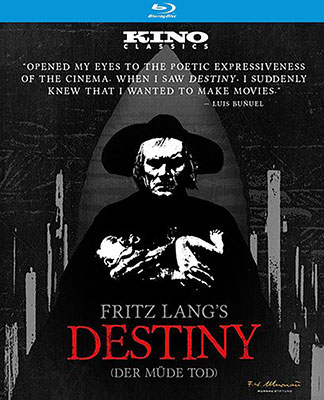
Kino Classics
2016 Blu-ray Disc edition
Destiny (1921), color-tinted and color-toned black & white and color-tinted black & white, 98 minutes, not rated.
Kino Lorber, K20719, UPC 7-38329-20719-9.
One single-sided, dual-layered, Region A Blu-ray Disc, 1.33:1 aspect ratio image in pillarboxed 16:9 (1920 x 1080 pixels) progressive scan AVC (MPEG-4) format, SDR (standard dynamic range), ? Mbps average video bit rate, ? Kbps audio bit rate, LPCM 48 kHz 2.0 stereo sound, German language intertitles, optional English language subtitles; 8 chapter stops; standard BD case; $29.95.
Release date: 30 August 2016.
Country of origin: USA
This Blu-ray Disc edition features a new 2K high-definition transfer of the restoration supervised by Anke Wilkening for the Friedrich-Wilhelm-Murnau-Stiftung, with the restored original German intertitles, and digitally-simulated historic color-tinting and color-toning of its original German theatrical release. As no original camera negatives have survived, the restoration team utilized conflated 35mm materials chiefly from two export versions of the film, one a 35mm duplicate negative held by the Museum of Modern Art and one a 35mm print held by Cinémathèque de Toulouse. Some additional footage from other sources have been inserted or utilized as reference material in the restoration. The color-tinting and toning contributes considerably to the presentation, as it adds atmosphere to the film and reduces the effect of some blasted-out highlights in some of the source material. Print flaws are still present in the restoration, such as speckling, dust, scratches both in the film base and in the emulsion, and brief clips of missing footage. However, that being said, this represents a tremendous improvement in picture quality over previous home video editions.
The film is presented with a fine newly-composed music score by Cornelius Schwehr commissioned by ZDF/ARTE and performed by the Berlin Rundfunk Symphony Orchestra under the direction of Frank Strobel.
Supplementary features include the original German intertitles with optional English subtitles, audio commentary by film historian Tim Lucas, and a comparison of black & white and color-tinted and toned footage (15 minutes).
We enthusiastically recommend this Blu-ray Disc edition as the best available on home video.
USA: Click the logomark to purchase this Region A Blu-ray Disc edition from Amazon.com. Your purchase supports Silent Era.
Canada: Click the logomark to purchase this Region A Blu-ray Disc edition from Amazon.ca. Your purchase supports Silent Era.
Kino Classics
2017 Blu-ray Disc edition
Fritz Lang: The Silent Films (1919-1929), color-tinted black & white and black & white, 1628 minutes total, not rated, including Destiny (1921), color-tinted and color-toned black & white and color-tinted black & white, 98 minutes, not rated.
Kino Lorber, K20997, UPC 7-38329-20997-1.
Twelve single-sided, dual-layered, Region A Blu-ray Discs, 1.33:1 aspect ratio image in pillarboxed 16:9 (1920 x 1080 pixels) progressive scan AVC (MPEG-4) format, SDR (standard dynamic range), ? Mbps average video bit rate, ? Kbps audio bit rate, Dolby Digital 48 kHz 2.0 stereo sound, German and English language intertitles, optional English language subtitles; chapter stops; hardbound album with slip-in die-cut cardboard pages in cardboard slipcase; $149.95.
Release date: 21 November 2017.
Country of origin: USA
This Blu-ray Disc edition is identical to the Kino Classics edition noted above.
The film is presented with a fine newly-composed music score by Cornelius Schwehr commissioned by ZDF/ARTE and performed by the Berlin Rundfunk Symphony Orchestra under the direction of Frank Strobel.
The supplemental material includes a 32-page booklet featuring an essay by Tom Gunning.
We highly recommend this Blu-ray Disc boxset, especially if you would like to collect all of Fritz Lang’s silent films in one fell swoop.
USA: Click the logomark to purchase this Region A Blu-ray Disc boxset from Amazon.com. Your purchase supports Silent Era.
Canada: Click the logomark to purchase this Region A Blu-ray Disc boxset from Amazon.ca. Your purchase supports Silent Era.
Kino Classics
2016 DVD edition
Destiny (1921), color-tinted and color-toned black & white and color-tinted black & white, 98 minutes, not rated.
Kino Lorber, K20718, UPC 7-38329-20718-2.
One single-sided, dual-layered, Region 1NTSC DVD disc, 1.33:1 aspect ratio image in pillarboxed 16:9 (720 x 480 pixels) MPEG-2 format, SDR (standard dynamic range), ? Mbps average video bit rate, ? Kbps audio bit rate, Dolby Digital 48 kHz 2.0 stereo sound, German language intertitles, optional English language subtitles; chapter stops; standard DVD keepcase; $24.95.
Release date: 30 August 2016.
Country of origin: USA
This remastered DVD edition features a new 2K high-definition transfer of the restoration supervised by Anke Wilkening for the Friedrich-Wilhelm-Murnau-Stiftung, with the restored original German intertitles, and digitally-simulated historic color-tinting and color-toning of its original German theatrical release. As no original camera negatives have survived, the restoration team utilized conflated 35mm materials chiefly from two export versions of the film, one a 35mm duplicate negative held by the Museum of Modern Art and one a 35mm print held by Cinémathèque de Toulouse. Some additional footage from other sources have been inserted or utilized as reference material in the restoration. The color-tinting and toning contributes considerably to the presentation, as it adds atmosphere to the film and reduces the effect of some blasted-out highlights in some of the source material. Print flaws are still present in the restoration, such as speckling, dust, scratches both in the film base and in the emulsion, and brief clips of missing footage. However, that being said, this represents a tremendous improvement in picture quality over previous home video editions.
The film is presented with a fine newly-composed music score by Cornelius Schwehr commissioned by ZDF/ARTE and performed by the Berlin Rundfunk Symphony Orchestra under the direction of Frank Strobel.
Supplementary features include the original German intertitles with optional English subtitles, audio commentary by film historian Tim Lucas, and a comparison of black & white and color-tinted and toned footage (15 minutes).
USA: Click the logomark to purchase this Region 1NTSC DVD edition from Amazon.com. Your purchase supports Silent Era.
Canada: Click the logomark to purchase this Region 1NTSC DVD edition from Amazon.ca. Your purchase supports Silent Era.
Masters of Cinema
2017 Blu-ray Disc / DVD edition
Destiny (1921), color-tinted black & white and color-toned black & white, 116 minutes, not rated.
Eureka Entertainment,
unknown catalog number, unknown UPC number.
One single-sided, dual-layered, Region B Blu-ray Disc, 1.33:1 aspect ratio image in pillarboxed 16:9 (1920 x 1080 pixels) progressive scan AVC (MPEG-4) format, SDR (standard dynamic range), ? Mbps average video bit rate, ? Kbps audio bit rate, Dolby Digital 48 kHz 2.0 stereo sound, German language intertitles, optional English language subtitles, chapter stops; and one single-sided, dual-layered, Region 2PAL DVD, 1.33:1 aspect ratio image in pillarboxed 16:9 (720 x 576 pixels) progressive? scan MPEG-2 format, SDR (standard dynamic range), ? Mbps average video bit rate, ? Kbps audio bit rate, Dolby Digital 48 kHz 2.0 stereo sound, German language intertitles, optional English language subtitles; chapter stops; standard BD keepcase; £19.99.
Release date: 24 July 2017.
Country of origin: England
This British dual-format Blu-ray Disc / PAL DVD edition has been restored by Anke Wilkening for the Friedrich-Wilhelm-Murnau-Stiftung. This updated presentation of Destiny features a new 2K high-definition transfer of the restoration, with the restored original German intertitles, and simulated historic color-tinting and color-toning of its original German release.
The film is presented with a newly-composed music score by Cornelius Schwehr commissioned by ZDF/ARTE and performed by the Berlin Rundfunk Symphony Orchestra under the direction of Frank Strobel.
Supplementary features include the original German intertitles with optional English subtitles, audio commentary by film historian Tim Lucas, and a comparison of black & white and color footage.
North American collectors will need a region-free Blu-ray Disc player and/or a region-free PAL DVD player capable of outputting an NTSC-compatible signal to view this edition.
United Kingdom: Click logomark to purchase this Region B Blu-ray / Region 2PAL DVD edition from Amazon.co.uk.
Flicker Alley
2015 DVD edition
Destiny (1921), color-toned black & white, 99 minutes, not rated.
Flicker Alley, 850025493, unknown UPC number.
One single-sided, single-layered, Region 0NTSC DVD-R disc, 1.33:1 aspect ratio image in windowboxed 4:3 (720 x 480 pixels) interlaced scan MPEG-2 format, SDR (standard dynamic range), ? Mbps average video bit rate, ? Kbps audio bit rate, Dolby Digital 48 kHz 2.0 stereo sound, English language intertitles, no foreign language subtitles; chapter stops; standard DVD case; $19.95.
Release date: 2015.
Country of origin: USA
This DVD-R edition will be significantly identical to the 2000 Image Entertainment edition noted below. It has been mastered from a 35mm fine-grain duplicate positive of the French rerelease version, with English language intertitles.
For an indication of edition quality, see our comments on the 2000 Image edition noted below.
USA: Click the logomark to purchase this Region 0NTSC DVD-R edition directly from . . .
Film Preservation Associates
2000 DVD edition
Destiny (1921), color-toned black & white, 99 minutes, not rated.
Film Preservation Associates, distributed by Image Entertainment, ID9411DSDVD, UPC 0-14381-94112-8.
One single-sided, single-layered, Region 0NTSC DVD disc, 1.19:1 aspect ratio image in windowboxed 4:3 (720 x 480 pixels) interlaced scan MPEG-2 format, SDR (standard dynamic range), 5.5 Mbps average video bit rate, 192 Kbps audio bit rate, Dolby Digital 48 kHz 2.0 stereo sound, English language intertitles, no foreign language subtitles; 12 chapter stops; snapper DVD case; $24.99.
Release date: 7 November 2000.
Country of origin: USA
Windowboxed transfer! We have long been proponents of windowbox tranfers of silent era films. Many silent films have survived in duped 35mm prints or in 16mm reduction prints that were made at a time when the goal to capture as much picture image as possible was not a concern. Television monitors do their own image cropping, leaving out a portion of the image all the way around a picture screen intentionally. The outside area cropped from a television picture is known as overscan. When silent films are transferred to full-frame television it is possible that the edges of intertitles and the tops of heads can be lost to overscan cropping. Windowbox transfers slightly shrink the whole image to fit within an area easily within the overscan cropping area of all televisions allowing the viewing of the complete surviving image.
The video transfer has been made from a 35mm French reissue print. Some framing shows the upper and lower right corners of the camera’s original aperture but not on the left, possibly indicating some image loss to an old optical soundtrack in a reissue print manufactured from a silent negative with processing equipment set-up for sound films with optical soundtracks. The minor loss of image is only apparent in off-center iris shots and slit shots like Death’s escorting the young woman up his long staircase beginning at 25:03.
Typefaces designed to resemble Gothic, Arabic and Asian typefaces have been used for intertitles to emulate the original fonts used in the German release prints. While we can appreciate the attempt to capture the feel of the original intertitles, and while the font may have looked good in the producer’s video editing suite, the intertitles are a little hard to read at their screen sizes in the lower resolution of NTSC, even on a big screen.
The surviving 35mm print itself is a bit contrasty. Some highlights are blasted to white and some shadows are pinched off to black. To compensate for the contrasty print, we found that some small amount of detail can be held in the shadows of shots by turning down the contrast and slightly raising the brightness on our television monitor up from a balanced standard. The transfer has been color-toned in a restrained sepia and blue, with black and white sections. The contrasty duplicate print is in very good condition, with some slight exposure fluctuations, light scratches, speckling, scuffing, some vertical scratches, and other minor damage including occasional frame jumps. Some shots feature a well-balanced greyscale range. We do question, however, whether the editing of this reissue print resembles Lang’s original edit as some sequences appear to be out of logical order.
In reevaluating the DVD on high-definition equipment with upscaling of the standard NTSC signal to 1080p, we regretfully have decided to lower our rating of the video quality of the disc. The tonal range of the surviving footage is too contrasty throughout to be offset by a number very-good looking shots. The overall visual quality is closer to commonly-viewed 16mm reduction prints.
The film presentation is enhanced by a small orchestra musicial accompaniment by The Mont Alto Motion Picture Orchestra. The music is comprised of adaptations of traditional German melodies and other authentically arranged scores to compile a very welcome and very pleasing film score. We have taken to playing the DVD while we work just to listen to the musical performance.
Overall, we believe the film has been more than adequately presented in home video by producer David Shepard, who has done the best possible work with a slightly compromised print coupled with an above-average musical accompaniment. We recommend this Fritz Lang addition to the silent era films available on DVD home video.
USA: Click the logomark to purchase this Region 0NTSC DVD edition from Amazon.com. Your purchase supports Silent Era.
Canada: Click the logomark to purchase this Region 0NTSC DVD edition from Amazon.ca. Your purchase supports Silent Era.
United Kingdom: Click the logomark to purchase this Region 0NTSC DVD edition from Amazon.co.uk. Support Silent Era.
Feel Films
2013 DVD edition
Destiny (1921), color-toned black & white, 75 minutes, not rated.
Feel Films, distributed by Resen,
ID9411DSDVD, UPC 8-436548-869755.
One single-sided, single-layered, Region 2PAL DVD disc, 1.33:1 aspect ratio image in full-frame 4:3 (720 x 576 pixels) interlaced scan MPEG-2 format, SDR (standard dynamic range), ? Mbps average video bit rate, ? Kbps audio bit rate, Dolby Digital 48 kHz 2.0 stereo sound, Spanish language intertitles, no foreign language subtitles; chapter stops; standard DVD keepcase; €19.99.
Release date: 2013.
Country of origin: Spain
This Spanish PAL DVD edition has likely been mastered from OK print materials, but beware the shorter running time than those of other home video editions.
North American collectors will need a region-free PAL DVD player capable of outputting an NTSC-compatible signal to view this edition.
United Kingdom: Click the logomark to purchase this Region 2PAL DVD edition from Amazon.co.uk. Purchase supports Silent Era.
Desert Island Films
2007 DVD edition
Destiny (1921), color-toned black & white, 99 minutes, not rated.
Desert Island Films,
unknown catalog number, unknown UPC number.
One single-sided, single-layered, Region 0NTSC DVD-R disc, 1.33:1 aspect ratio image in windowboxed 4:3 (720 x 480 pixels) interlaced scan MPEG-2 format, SDR (standard dynamic range), ? Mbps average video bit rate, ? Kbps audio bit rate, Dolby Digital 48 kHz 2.0 stereo sound, English language intertitles, no foreign language subtitles; chapter stops; standard DVD keepcase; $19.99.
Release date: 2007.
Country of origin: USA
David Shepard reported that this DVD edition is a pirated release of his legal Image Entertainment edition from 2000 that is noted above.
Our readers are encouraged to totally ignore this completely ripped-off edition, whether on disc or Amazon streaming.