Silent Era Home Page > Home Video > Dr. Mabuse, the Gambler

Reviews of silent film releases on home video.
Copyright © 1999-2024 by Carl Bennett
and the Silent Era Company.
All Rights Reserved. |
|
Dr. Mabuse,
the Gambler
(1922)
|
Dr. Mabuse is a master manipulator and hypnotist. A mysterious and largely unknown force, he manipulates the stock market to disrupt the business and lives of those who are abusing and eroding the German economy. He controls the minds of the idle rich who gamble away money, when millions of Germans languish in hunger on the streets outside the gambling clubs. Mabuse seeks to destroy those who are nothing to him but worthless cattle.
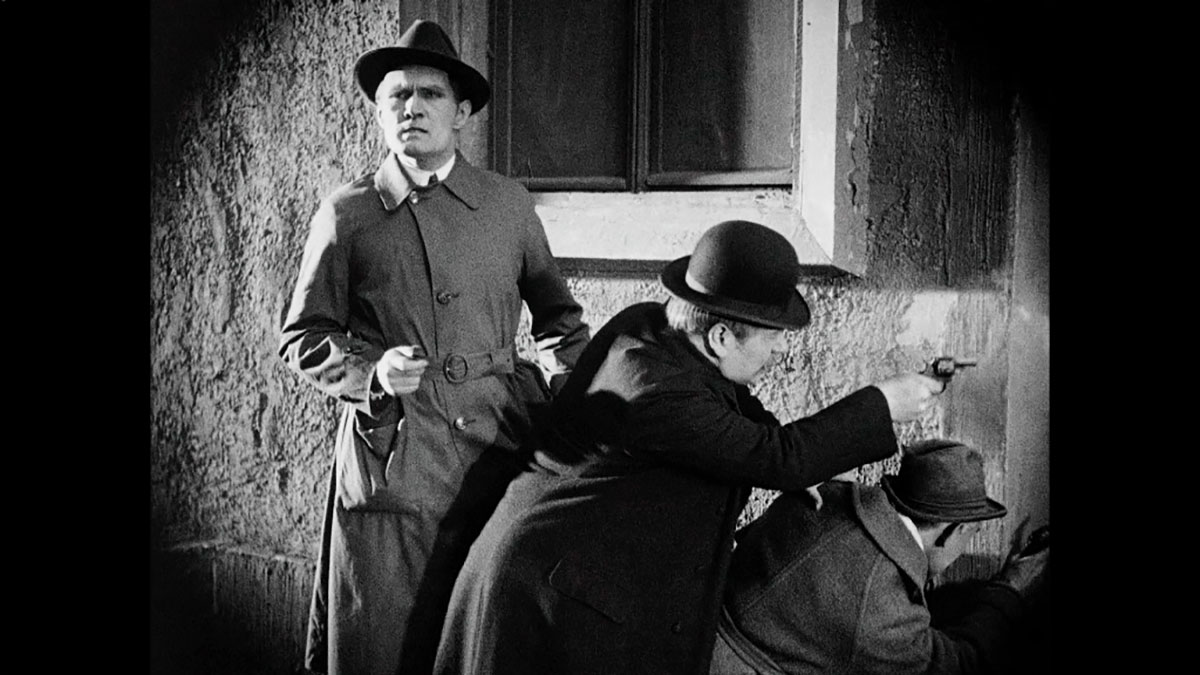
State attorney von Wenk has been working to shut down the illicit gambling casinos, but he has discovered that a ‘great unknown’ criminal has been preying upon the very people that von Wenk is trying to prosecute. This evil criminal has been striking in disguise, remaining unidentifiable and untraceable. Von Wenk must resort to disguises himself to track and catch the criminal ring and its mysterious leader.
From that point onward, von Wenk pursues that which he can’t identify and Mabuse tries to stop that which he can’t destroy. Mabuse manipulates his slavish criminal pawns in a deadly chess game of attack and evasion, outmanuvering the outmanned von Wenk. Along the way, both von Wenk and Mabuse meet the Countess Dusy Told, who changes the course of both their lives. That which subverts Mabuse’s plot is love in a distorted, wholly external form. It is something that Mabuse does not acknowledge and cannot resist, in the form of the two feminine influences, the dancer and Mabusian agent La Carozza and Countess Told.
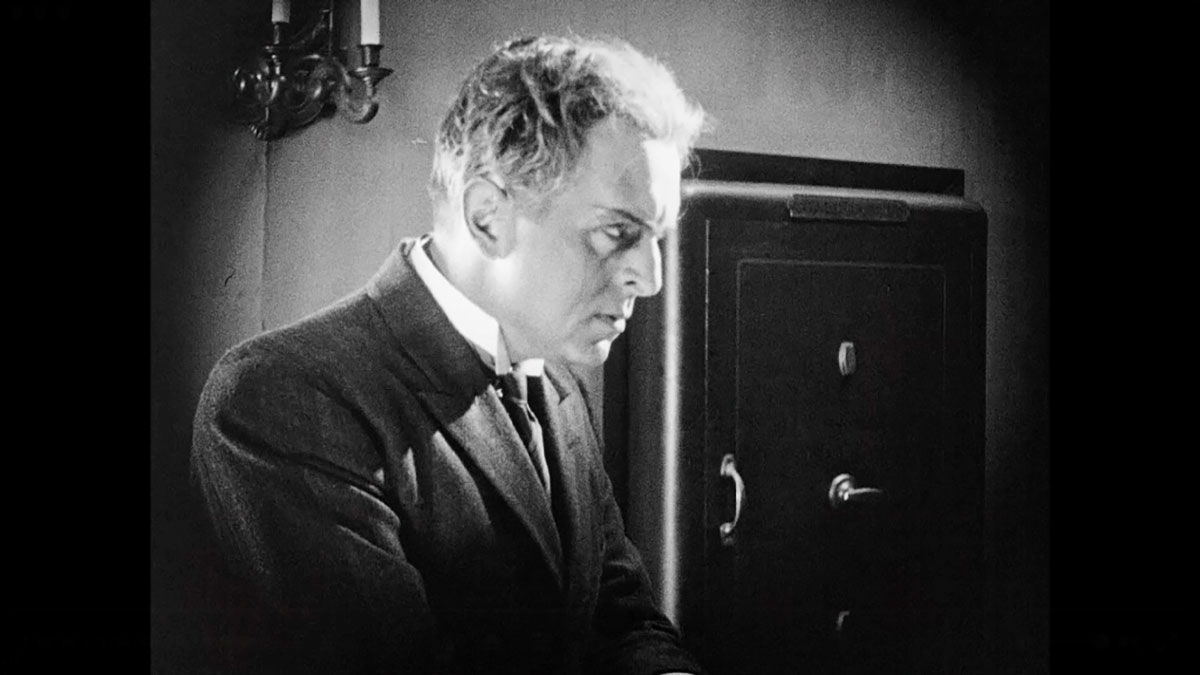
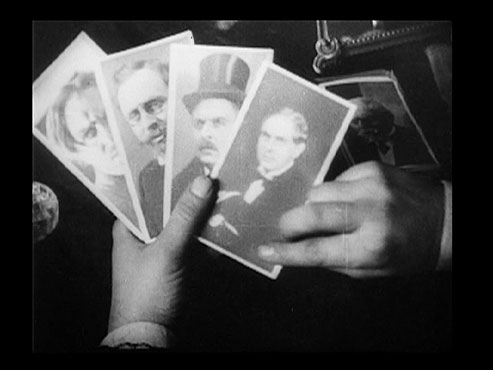
Fritz Lang worked closely with the author of the serialized Mabuse novel Norbert Jacques and with writing collaborator Thea von Harbou on the adaptation of this criminal thriller story, with its undercurrent of antidecadence social commentary. Lang was still exploring his cinematic vision during the production of Dr. Mabuse; learning how to refine the visual statements he desired to make, and how to examine the questions of his own personal and professional life. The sequence where Mabuse first hypnotizes von Wenk is very stylish and was quite dazzling for audiences in the 1920s. And we have always enjoyed the Petit Casino sequence, with its circular gambling den. There are several standout visual sequences in this highly respected and influential Lang film.
— Carl Bennett
|
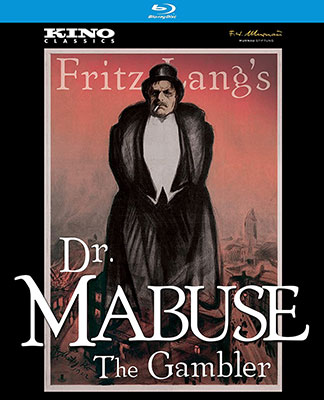 Kino Classics Kino Classics
2016 DVD edition
Dr. Mabuse, the Gambler (1922), black & white, 270 minutes, not rated.
Kino Lorber, K20630, UPC 7-38329-20630-7.
Two single-sided, dual-layered, Region A Blu-ray Discs; 1.33:1 aspect ratio picture in pillarboxed 16:9 (1920 x 1080 pixels) 24 fps progressive scan image encoded in SDR AVC format at 26.8 Mbps average video bit rate; LPCM 2.0 stereo sound encoded at 1.5 Mbps audio bit rate; German language intertitles, optional English language subtitles; 8 chapter stops (disc 1) and 8 chapter stops (disc 2); standard two-disc BD keepcase; $39.95.
Release date: 13 September 2016.
Country of origin: USA
Ratings (1-10): video: 8 / audio: 7 / additional content: 7 / overall: 7.
|
This Kino Blu-ray Disc edition of the German crime drama has been mastered at 2K high-resolution from the 2000 restoration version of the film by Bundesarchiv-Filmarchiv Berlin, the Filmmuseum im Stadtmuseum Munchen and controlled by the Friedrich-Wilhelm-Murnau-Stiftung of Germany of Germany, which features additional footage not available in other home video editions.
The film is accompanied by a music score composed and performed on piano by Aljoscha Zimmermann with a small ensemble of violin, cello and tuned percussion.
Supplemental material includes the three-part featurette produced by Transit Film GmbH “The Story Behind Dr. Mabuse” in German with permanent English subtitles and featuring Aljoscha Zimmermann, author Michael Farin and Fritz Lang in filmed interviews from 1965 and 1968 (52 minutes total).
This is our recommended home video edition of the film. You will do what I say. Buy this disc now! Melior! Melior!
|
|
USA: Click the logomark to purchase this Region A Blu-ray Disc edition from Amazon.com. Your purchase supports Silent Era.
|

|
|
|
Canada: Click the logomark to purchase this Region A Blu-ray Disc edition from Amazon.ca. Your purchase supports Silent Era.
|

|
|
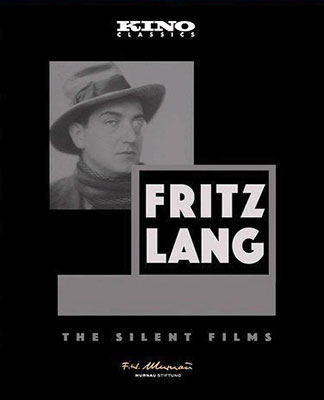 Kino Classics Kino Classics
2017 Blu-ray Disc edition
Fritz Lang: The Silent Films (1919-1929), color-tinted black & white and black & white, 1628 minutes total, not rated, including Dr. Mabuse, the Gambler (1922), black & white, 270 minutes, not rated.
Kino Lorber, K20997, UPC 7-38329-20997-1.
Two single-sided, dual-layered, Region A Blu-ray Discs (12 BDs in the set); 1.33:1 aspect ratio picture in pillarboxed 16:9 (1920 x 1080 pixels) 24 fps progressive scan image encoded in SDR AVC format at 26.8 Mbps average video bit rate; LPCM 2.0 stereo sound encoded at 1.5 Mbps audio bit rate; German language intertitles, optional English language subtitles; 8 chapter stops (disc one) and 8 chapter stops (disc two); 32-page insert booklet; hardbound album with slip-in die-cut cardboard pages in cardboard slipcase; $149.95.
Release date: 21 November 2017.
Country of origin: USA
Ratings (1-10): video: 8 / audio: 7 / additional content: 8 / overall: 8.
|
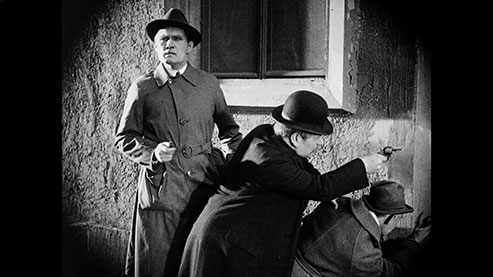
This Blu-ray Disc edition is identical to the Kino Classics edition noted above.
The film is accompanied by a music score composed and performed on piano by Aljoscha Zimmermann with a small ensemble of violin, cello and tuned percussion.
Supplemental material includes the three-part featurette produced by Transit Film GmbH “The Story Behind Dr. Mabuse” in German with permanent English subtitles and featuring Aljoscha Zimmermann, author Michael Farin and Fritz Lang in filmed interviews from 1965 and 1968 (52 minutes total); and a 32-page booklet featuring an essay by Tom Gunning.
We highly recommend this Blu-ray Disc boxset, especially if you would like to collect all of Fritz Lang’s silent films in one fell swoop.
|
|
USA: Click the logomark to purchase this Region A Blu-ray Disc boxset from Amazon.com. Your purchase supports Silent Era.
|
|
|
|
Canada: Click the logomark to purchase this Region A Blu-ray Disc boxset from Amazon.ca. Your purchase supports Silent Era.
|
|
|
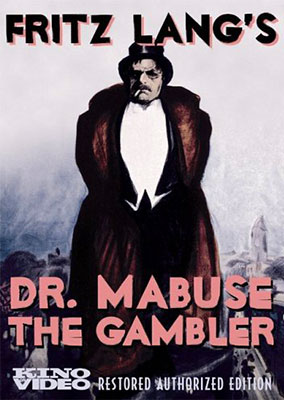 Kino on Video Kino on Video
2006 DVD edition
Dr. Mabuse, the Gambler (1922), black & white, 270 minutes, not rated.
Kino International, K466, UPC 7-38329-04662-0.
Two single-sided, dual-layered, Region 0 NTSC DVD discs; 1.33:1 aspect ratio picture in full-frame 4:3 (720 x 480 pixels) interlaced scan image encoded in SDR MPEG-2 format at 6.8 Mbps average video bit rate (capable of progressive scan upscaling to 60 fps); Dolby Digital (AC3) 2.0 stereo sound encoded at 192 Kbps audio bit rate; English language intertitles, no foreign language subtitles; 15 chapter stops (disc one) and 12 chapter stops (disc two); double-wide two-disc DVD keepcase; $39.95.
Release date: 18 July 2006.
Country of origin: USA
Ratings (1-10): video: 7 / audio: 7 / additional content: 7 / overall: 7.
|
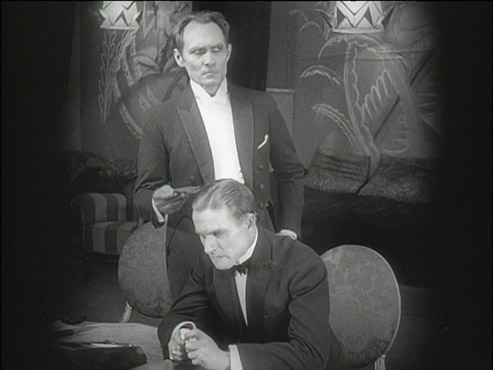
This Kino DVD edition of the German crime drama has been mastered from the 2000 restoration version of the film by Bundesarchiv-Filmarchiv Berlin, the Filmmuseum im Stadtmuseum Munchen and controlled by the Friedrich-Wilhelm-Murnau-Stiftung of Germany, which features additional footage not available in other home video editions. The print has a typical amount of dust, speckling, schmutz, emulsion scrapes, exposure fluctuations and other flaws in its otherwise very-good to excellent picture.
The film is accompanied by a music score composed and performed on piano by Aljoscha Zimmermann with a small ensemble of violin, cello and tuned percussion.
Supplemental material includes the three-part featurette produced by Transit Film GmbH “The Story Behind Dr. Mabuse” in German with permanent English subtitles and featuring Aljoscha Zimmermann, author Michael Farin and Fritz Lang in filmed interviews from 1965 and 1968 (52 minutes total); a stills gallery (16 images); and film notes including a Lang biography (11 screens) and a filmography (10 screens), facts and dates (one screen), and information about the restoration (one screen).
This remains our recommended DVD home video editon of the film.
|
|
USA: Click the logomark to purchase this Region 0 NTSC DVD edition from Amazon.com. Your purchase supports Silent Era.
|
|
|
|
Canada: Click the logomark to purchase this Region 0 NTSC DVD edition from Amazon.ca. Your purchase supports Silent Era.
|
|
|
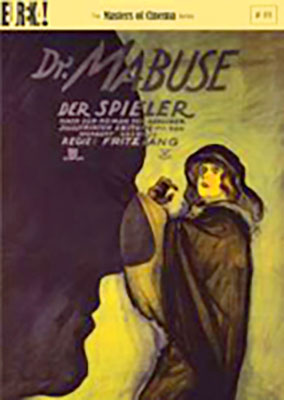 Eureka Entertainment Eureka Entertainment
2009 DVD edition
The Complete Fritz Lang Mabuse Boxset (1922-1960), black & white, 485 minutes total, BBFC Classification PG, including Dr. Mabuse, the Gambler (1922), black & white, 270 minutes, BBFC Classification PG.
Eureka Entertainment,
unknown catalog number (MoC89), unknown UPC number.
Four single-sided, dual-layered, Region 2 PAL DVD discs, 1.33:1 aspect ratio image in full-frame 1.33:1 (720 x 576 pixels) progressive? scan MPEG-2 format, SDR (standard dynamic range), ? Mbps average video bit rate, ? Kbps audio bit rate, Dolby Digital 48 kHz 2.0 mono sound, German language intertitles, optional English language subtitles; chapter stops; four standard DVD keepcases in cardboard slipcase; £49.99.
Release date: 19 October 2009.
Country of origin: England
|
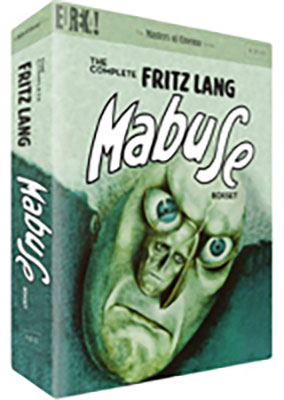 This PAL DVD edition, which is only available in The Complete Fritz Lang Mabuse Boxset collection from Eureka Entertainment, has been mastered from the 2000 restoration version of the film by Bundesarchiv-Filmarchiv Berlin, the Filmmuseum im Stadtmuseum Munchen and licensed by the F.W. Murnau Stiftung of Germany, which features additional footage not available in other home video editions. This PAL DVD edition, which is only available in The Complete Fritz Lang Mabuse Boxset collection from Eureka Entertainment, has been mastered from the 2000 restoration version of the film by Bundesarchiv-Filmarchiv Berlin, the Filmmuseum im Stadtmuseum Munchen and licensed by the F.W. Murnau Stiftung of Germany, which features additional footage not available in other home video editions.
Supplemental material includes full-length audio commentary by film scholar David Kalat, an interview with the restoration music score composer, a discussion of Mabuse creator Norbert Jacques, and an examination of the film’s context within German silent cinema.
North American collectors will need a region-free PAL DVD player capable of outputting an NTSC-compatible signal to view this edition.
|
|
United Kingdom: Click the logomark to purchase this Region 2 PAL DVD edition from Amazon.co.uk. Support Silent Era.
|

|
|
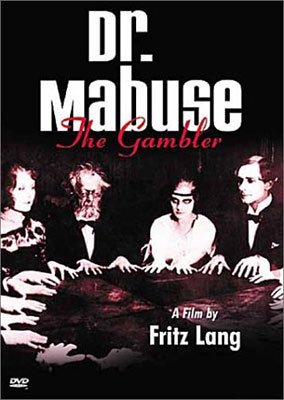 Film Preservation Associates Film Preservation Associates
2001 DVD edition
Dr. Mabuse, the Gambler (1922), black & white, 213 minutes, not rated.
Film Preservation Associates, distributed by Image Entertainment, ID9412DSDVD, UPC 0-14381-94122-7.
Two single-sided, dual-layered, Region 0 NTSC DVD discs; 1.33:1 aspect ratio picture in windowboxed 4:3 (720 x 480 pixels) interlaced scan image encoded in SDR MPEG-2 format at 5.5 Mbps average video bit rate (capable of progressive scan upscaling to ? fps); Dolby Digital (AC3) 2.0 stereo sound encoded at 224 Kbps audio bit rate; English language intertitles, no foreign language subtitles; 32 chapter stops; double-wide two-disc DVD keepcase; $39.99.
Release date: 28 August 2001.
Country of origin: USA
Ratings (1-10): video: 7 / audio: 9 / additional content: 8 / overall: 8.
|
Throw them away. Throw away those nasty old VHS videotape editions of Fritz Lang’s master criminal epic, Dr. Mabuse, the Gambler (1922). Previous home video editions have been based on poor 16mm reduction prints of the original two-part film or, worse, transferred from the 1927 USA abridgement entitled The Fatal Passions of Dr. Mabuse, cut to a mere 90 minutes, which itself was based on a poorly-translated British edition of the film.
Now we have this fine home video edition prepared by David Shepard of Film Preservation Associates. For the first time on quality home video, we have the nearly complete two-part epic that is Dr. Mabuse, The Gambler. We were very pleased to see the film presented in a windowbox video transfer from a very-good 35mm print. Windowbox presentations allow the maximum amount of picture image in the surviving print to be seen on all television monitors, with nothing lost to television picture cropping.
Generally the 35mm print maintains a broad range of greytones and image detail in both highlights and shadows, but at times some highlight details are lost. The print is marked with light speckling, mild frame jitters, print notations, emulsion chipping and other minor print damage of the sort, with insignificant bits of footage lost to print splices. It is noted in the audio commentary that previous home video editions have run up to approximately 200 minutes. The running time of this new Image edition is 213 minutes. New English language intertitles have been translated from the original German by Ulrich Ruedel, and have been digitally reset on a tasteful dark mottled grey background.
In reevaluating the DVD set on high-definition equipment, the video transfer plays well on HD systems when the standard NTSC signal is upscaled to 1080p, however the source print material is in reality a little rougher than originally rated.
Disc one includes an insightful commentary by Mabuse scholar David Kalat, author of The Strange Case of Dr. Mabuse: A Study of the Twelve Films and Five Novels. Kalat’s commentary discusses Lang’s debt to French filmmaker Louis Feuillade’s sensational Fantomas films and his later serial thriller Les vampires (1915-1916). Kalat answers the questions that rise in the minds of audiences on first viewings, such as why von Wenk does not close down the casinos and gambling houses that he manages to discover. He explains von Wenk’s motivation and his circuitous methods. Kalat notes that there is missing footage in this edition of the first part for Dr. Mabuse, he details what action occurs in the missing footage and explains the significance (of the lack of such) to the surrounding narrative of the missing footage. There is a scene early in the film where Dr. Mabuse appears in his public persona as a psychoanalyst addressing a gathering of his professional peers. There is missing footage in the Folies Bergères sequence, and also when von Wenk chases Mabuse into the Hotel Excelsior. Disc two ends with the title card, “Part One was slightly abridged by Erwin Leiser with the concurrence of Fritz Lang,” which goes unexplained.
Disc two’s commentary opens with a lengthy discussion of author Norbert Jacques, his career, the novel, and the impact of Mabuse on his life. Also discussed are details on the political and socioeconomic environment of the Weimar Republic as a background to the social commentary embedded in Jacques novel and Lang’s film. There is the theme of suicide throughout Lang’s films, very likely linked to the death of Lang’s first wife Lisa Rosenthal. Also covered is the high era of cultural development in the Weimar Republic, Lang’s personal background, Alfred Abel’s contribution as actor to Lang films, which leads to a discussion of Metropolis (1927) and Lang’s cinema of self-destruction. There is a look at the Mabuse tradition and its adaptation in later spy films such as the British James bond films, and a discussion of the art direction of the Mabuse film by Otto Hunte and others. There are also parallels between the conclusions of Mabuse and Hitchcock’s The Man Who Knew Too Much (1934). The structure of the ending of the film, with Mabuse’s escape from the gunfight between police and Mabuse’s agents and his ultimate breakdown, the politics and significance of the lack of any social commentary conclusions (no answers from Lang) is also discussed in some detail. Kalat notes that there is appearently no missing footage in part two.
Kalat does not take himself too seriously and thus keeps the audio commentary from bogging down to a dull college lecture. He even notes that during the course of his own research on the Mabuse films, he has had to debunk previous assumptions (those of himself and others) when new facts came to light. The commentary becomes a valuable reference text that can be used in conjunction with Kalat’s own book on things Mabuse. The commentary track has a glitchy three-time repeat beginning at 1:29:03 of disc two, which may have been an unedited reading mistake by Kalat.
Which leads us to the great musical accompaniment of this film. We have always been enthusiastic about Robert Israel’s silent era film musical arrangements and compositions. This well-recorded stereo music score features piano with an ensemble, and tastefully and appropriately augments the action of the film. We are quite pleased that recent silent film home video editions increasingly utilize the talents of accomplished musicians that perform on acoustic instruments that are contemporary to the films.
We are also pleased that the edition has been released on two discs rather than one DVD-18 (dual-sided, dual-layered) disc. It neatly points up the fact that was originally a two-part film that was to be seen in two separate but chronological viewings. We also like the fact that Image DVDs are now being released in plastic keep cases rather than cardboard and plastic snapper cases.
Overall, this edition of Dr. Mabuse, the Gambler is nearly perfect, compromised only by the slightly abbreviated but acceptable survival state of the 35mm print (the best we have seen of this film). The music and the audio commentary are valuable assets in this quality edition, with the windowboxed video transfer a fine example of how silent films should be presented on home video.
|
|
USA: Click the logomark to purchase this Region 0 NTSC DVD edition from Amazon.com. Your purchase supports Silent Era.
|
|
|
|
Canada: Click the logomark to purchase this Region 0 NTSC DVD edition from Amazon.ca. Your purchase supports Silent Era.
|
|
|
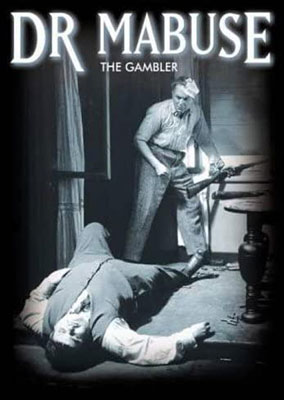 Eureka Entertainment Eureka Entertainment
2004 DVD edition
Dr. Mabuse, the Gambler (1922), black & white, 271 minutes, BBFC Classification PG.
Eureka Entertainment, EKA40068, UPC 5-060000-401998.
Two single-sided, dual-layered, Region 2 PAL DVD discs, 1.33:1 aspect ratio image in full-frame 1.33:1 (720 x 576 pixels) interlaced? scan MPEG-2 format, SDR (standard dynamic range), ? Mbps average video bit rate, ? Kbps audio bit rate, Dolby Digital 48 kHz 2.0 stereo sound, German language intertitles, optional English and French language subtitles, chapter stops; cardboard wrapper with two plastic trays in cardboard slipcase; £24.99.
Release date: 24 May 2004.
Country of origin: England
|
|
This PAL DVD edition also includes a three-part documentary, photo gallery, and other supplemental items.
The film is accompanied by a music score composed and performed on piano by Aljoscha Zimmermann with a small ensemble of violin, cello and tuned percussion.
Supplemental material includes the three-part featurette produced by Transit Film GmbH “The Story Behind Dr. Mabuse” in German with English subtitles and featuring Aljoscha Zimmermann, author Michael Farin and Fritz Lang in filmed interviews from 1965 and 1968; a stills gallery; and other items.
North American collectors will need a region-free PAL DVD player capable of outputting an NTSC-compatible signal to view this edition.
|
|
United Kingdom: Click the logomark to purchase this Region 2 PAL DVD edition from Amazon.co.uk. Support Silent Era.
|
|
|
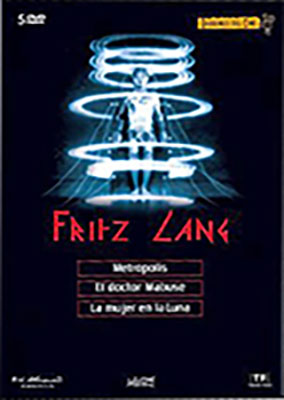 Divisa Home Video Divisa Home Video
2013 DVD edition
Fritz Lang (1922-1929), black & white, 579 minutes total, not rated, including El Doctor Mabuse [Dr. Mabuse, the Gambler] (1922), black & white, 272 minutes, not rated.
Divisa Home Video,
unknown catalog number, UPC 8-421394-540811.
Two single-sided, dual-layered, Region 2 PAL DVD discs (five DVDs in the set); 1.33:1 aspect ratio image in full-frame 4:3 (720 x 576 pixels) interlaced scan MPEG-2 format, SDR (standard dynamic range), ? Mbps average video bit rate, ? Kbps audio bit rate, Dolby Digital 48 kHz 5.1 surround sound and Dolby Digital 48 kHz 2.0 stereo sound, Spanish? language intertitles, no foreign language subtitles; chapter stops; standard five-disc DVD keepcase; unknown suggested list price.
Release date: 2013.
Country of origin: Spain
|
|
This Spanish PAL DVD edition has likely been mastered from 35mm print materials.
This edition would probably be most valuable to Spanish and Portuguese-speaking viewers.
North American collectors will need a region-free PAL DVD player capable of outputting an NTSC-compatible signal to view this edition.
|
|
USA: Click the logomark to purchase this Region 2 PAL DVD edition from Amazon.com. Your purchase supports Silent Era.
|
|
|
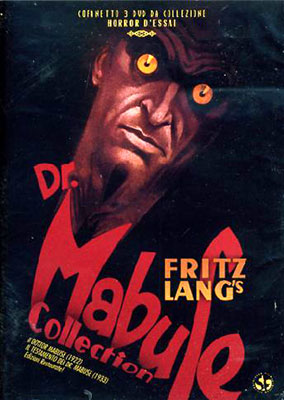 Sinister Film Sinister Film
2009 DVD edition
Fritz Lang’s Dr. Mabuse Collection (1922-1933), black & white, 391 minutes total, not rated, including Il Dottor Mabuse [Dr. Mabuse, the Gambler] (1922), black & white, 271 minutes, not rated.
Sinister Film, unknown catalog number, UPC 8-017229-867156.
Three single-sided, dual-layered, Region 2 PAL DVD discs, 1.33:1 aspect ratio image in full-frame 4:3 (720 x 576 pixels) interlaced? scan MPEG-2 format, SDR (standard dynamic range), ? Mbps average video bit rate, ? Kbps audio bit rate, Dolby Digital 48 kHz 2.0 stereo sound and Dolby Digital 48 kHz 2.0 mono sound, German language intertitles, optional Italian language subtitles; chapter stops; standard three-disc DVD keepcase; unknown suggested list price.
Release date: 2009.
Country of origin: Italy
|
|
This Italian PAL DVD edition has likely been mastered from 35mm print materials.
This edition would probably be most valuable to Italian-speaking viewers.
North American collectors will need a region-free PAL DVD player capable of outputting an NTSC-compatible signal to view this edition.
|
|
USA: Click the logomark to purchase this Region 2 PAL DVD edition from Amazon.com. Your purchase supports Silent Era.
|
|
|
|
Canada: Click the logomark to purchase this Region 2 PAL DVD edition from Amazon.ca. Your purchase supports Silent Era.
|
|
|
|
Other silent era FRITZ LANG films available on home video.
Other GERMAN FILMS of the silent era available on home video.
Other CRIME FILMS of the silent era available on home video.
Other silent film music scores by ROBERT ISRAEL available on home video.
|
|

LINKS IN THIS COLUMN
WILL TAKE YOU TO
EXTERNAL WEBSITES
•
SUPPORT SILENT ERA
USING THESE LINKS
WHEN SHOPPING AT
AMAZON



•





























































•
|