Silent Era Home Page > Home Video > Othello

Reviews of silent film releases on home video.
Copyright © 1999-2024 by Carl Bennett
and the Silent Era Company.
All Rights Reserved. |
Othello
(1922) |
What happens when Germany’s greatest silent era actor Emil Jannings and stylish character actor Werner Krauss perform one of Shakespeare’s greatest plays for the camera? Well, unfortunately, quite a bit of mugging, eyepopping and unintentionally hammish acting. And while we love Jannings’ performances elsewhere, we don’t know whether his sometimes over-the-top turn here is solely his take on Othello or is the result of misguided instruction from the film’s director Dmitri Buchowetzki. Jannings and Krauss, curiously, are unable to engage the film audience.
While the film can be intriguing to the uninitiated due to the presence of Jannings and Krauss, it is also distressingly unimaginatively directed by Buchowetzki. His camera setups and choice of backgrounds, sometimes a view of large, elaborately dressed sets or nothing more than a dark drape, do little more than frame the actors’ off-the-mark performances.
More than two years after the release of The Cabinet of Dr. Caligari (1920), talented Werner Krauss gives us his interpretation of one of drama’s great villains. But his Iago is less the traitorous snake of Shakespeare’s play and more a oddly-moustached spoilt prig in black jammies — more an overweight man-child in kneepants from a W.C. Fields comedy. At times Krauss looks disconcertingly like Mack Swain in Ambrose makeup and looks foolish with his exaggerated gesticulation and galloping.
Along the same vein, poor comical Roderigo (Ferdinand von Alten) looks more than a little like a Black Adder ancestor.
While there is much to take in when viewing this film, with the viewer becoming gradually more detached from the story and left to admire the staging, it is guilty of a venial sin — that of being a little dull and uninspired.
— Carl Bennett
|
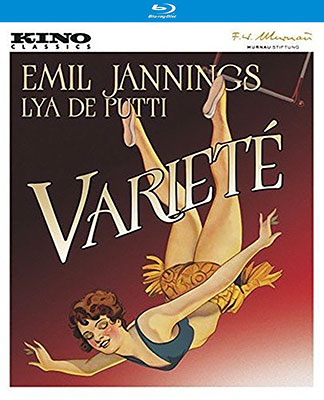 Kino Classics Kino Classics
2017 Blu-ray Disc edition
Varieté (1925) [German release version], color-tinted black & white, 95 minutes, not rated, with Othello (1922), black & white, ? minutes, not rated.
Kino Lorber,
unknown catalog number, unknown UPC number.
One single-sided, dual-layered, Region A Blu-ray Disc, 1.33:1 aspect ratio image in pillarboxed 16:9 (1920 x 1080 pixels) progressive scan AVC (MPEG-4) format, SDR (standard dynamic range), ? Mbps average video bit rate, ? Mbps audio bit rate, LPCM 48 kHz 2.0 stereo sound, German? language intertitles, optional English? language subtitles, chapter stops; standard BD keepcase; $29.95.
Release date: 22 August 2017.
Country of origin: USA
|
|
This Blu-ray Disc edition may be mastered from a 35mm print of the American release version of the film.
The film is accompanied by a music score.
It is unknown at this time whether this edition will be recommended.
|
|
USA: Click the logomark to purchase this Region A Blu-ray Disc edition from Amazon.com. Your purchase supports Silent Era.
|

|
|
|
Canada: Click the logomark to purchase this Region A Blu-ray Disc edition from Amazon.ca. Your purchase supports Silent Era.
|

|
|
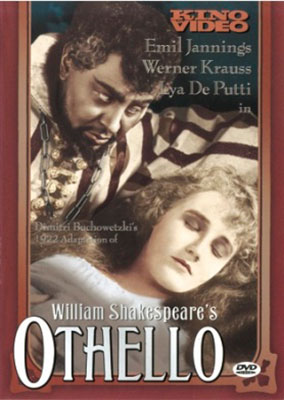 Kino on Video Kino on Video
2001 DVD edition
Othello (1922), black & white, 80 minutes, not rated, with Duel Scene from Macbeth (1905), black & white, 1 minute, not rated, The Taming of the Shrew (1908), black & white, 11 minutes, not rated, Romeo Turns Bandit (1910), black & white, 6 minutes, not rated, and Desdemona (1911), black & white, 23 minutes, not rated.
Kino International, K181, UPC 7-38329-01812-2.
One single-sided, single-layered, Region 1 NTSC DVD disc, 1.33:1 aspect ratio image in full-frame 4:3 (720 x 480 pixels) interlaced scan MPEG-2 format, SDR (standard dynamic range), 4.0 Mbps average video bit rate, 192 Kbps audio bit rate, Dolby Digital 48 kHz 2.0 stereo sound, English language intertitles, no foreign language subtitles, 16 chapter stops; standard DVD keepcase; $29.95.
Release date: 26 June 2001.
Country of origin: USA
Ratings (1-10): video: 7 / audio: 8 / additional content: 7 / overall: 7.
|
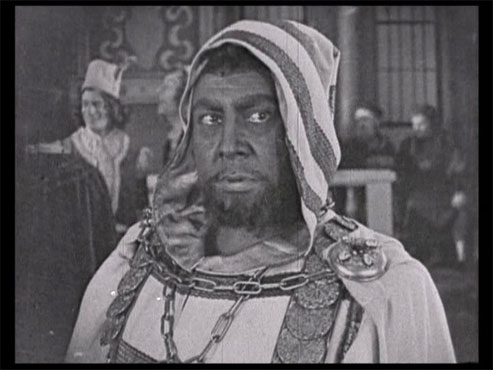
For this Kino DVD edition’s video transfer a worn but clear 35mm print was utilized, originating from a 1920s release print prepared by Ben Blumenthal’s Export & Import Film Company, Incorporated, for the American film market. All intertitles are in English and appear to be the American originals. The image is generously cropped for television, with ample space around even the sometimes lengthy intertitle cards. While the video transfer made at proper running speed is gorgeous, the print is compromised by wear from use: fine scratches and scuffing, sometimes not subtle emulsion damage, mild frame jitters, and a nearly constant fine sprinkling of white speckling. The print, however, holds a broad range of greytones and fine detail, and is a generally pleasure to watch. At times the continuity seems a little choppy and may be the result of some editing in the original American print.
Accompanying Othello are four earlier Shakespearean film adaptations. Duel Scene from Macbeth (1905) is a static swordplay battle between two actors in front of a painted backdrop. Produced by Biograph for a series of short films on historic fights and shot by G.W. Bitzer, the film has next to nothing Shakespearean about it other than its title and period costumes. However, little other can be accomplished in a film adaptation of Shakespeare in less than a minute. The print is from the Library of Congress’ paper print collection.
The Taming of the Shrew (1908), an early film from D.W. Griffith, plays much of the story for slapstick. Necessarily, with the technological confines of the silent film, the film had to be adapted as a broad comedy or as something more of a drama than Shakespeare intended. Here the slapstick is likely intended to capture the comic tone of the play. The print has the shortcomings of many of the Library of Congress paper prints, those being a contrasty picture, frame jitters, exposure fluctuations, etc. But the print is complete and remains quite viewable.
Romeo Turns Bandit (1910) is a Max Linder comedy adaptation of Romeo and Juliet in modern dress. Romeo overcomes Juliet’s father’s objections by kidnapping her then rescuing her. The print utilized originates from an original American release print and has faded from its original hand-colored brilliance (in the Pathécolor stencil process) to a pale wash of implied color. Brief flashes of color throughout the film, where the color hasn’t completely faded, offer an idea of how the print once looked. The print has also survived in a slightly damaged state, with the picture jumping out of frame briefly a couple of times during the film. The picture even flips upside down (we think unintentionally) for a few seconds at 2:24 into the film. The ending has not completely survived in this print and is abbreviated, being nothing more than a few double-printed frames to imply the closing shots.
Desdemona (1911), the American release title of the Danish film For Åbent Taeppe (1911), is an adventurous adaptation of the Othello story. A husband and wife acting team are rehearsing a stage production of Othello. Offstage the wife is entertaining the affections of a rich admirer. The actor portraying Iago brings the unfortunate news to the actor playing Othello that his wife has been seeing another man. During the first performance of the play, the actor as Othello is so consumed by jealousy and rage that he strangles his actress wife at the moment when Othello kills Desdemona. The print utilized for transfer originates from the Library of Congress’ paper print collection and appears to have been transferred from a 35mm restoration print of the film. Other than the graininess of the source paper print, the restoration print features better image detail (still, only about the quality of budget 16mm prints) than The Taming of the Shrew, and relatively even exposures from frame to frame throughout. Color tinting has been added to indicate evening scenes and new video-generated titles have been inserted.
Musical accompaniment for the entire program was performed by Jon C. Mirsalis on piano, in clearly recorded digital stereo. As always, Mirsalis’s accompaniment is well performed, appropriate to the action and tasteful.
This disc and Kino’s edition of Richard III (1912) make valuable companions to Milestone Film & Video’s DVD release of short silent era Shakespearean films Silent Shakespeare. And while we wanted to enjoy this film more (and our opinion is unchanged since seeing this film for the first time several years ago), we cannot escape the conclusion that the lead actors’ performances are misguided just when they need to soar to evil and tragic heights. Much of the blame rests, we think, on director Buchowetzki’s shoulders. We recommend this Kino DVD-only release on the merits of the well managed home video edition more than on the merits of the film itself. Collectors can rest assured that this is the best home video edition of Othello available.
|
|
USA: Click the logomark to purchase this Region 1 NTSC DVD edition from Amazon.com. Your purchase supports Silent Era.
|
|
|
|
Canada: Click the logomark to purchase this Region 1 NTSC DVD edition from Amazon.ca. Your purchase supports Silent Era.
|
|
|
|
This Region 1 NTSC DVD is also available directly from . . .
|

|
|
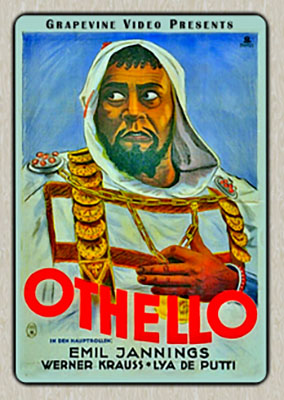 Grapevine Video Grapevine Video
2016 DVD edition
Othello (1922), black & white, 75 minutes, not rated.
Grapevine Video, no catalog number, UPC 6-60845-44779-0.
One single-sided, single-layered, Region 0 NTSC DVD-R disc, 1.33:1 aspect ratio image in full-frame 4:3 (720 x 480 pixels) interlaced scan MPEG-2 format, SDR (standard dynamic range), ? Mbps average video bit rate, ? Kbps audio bit rate, Dolby Digital 48 kHz 2.0 stereo sound, English language intertitles, no foreign language subtitles, chapter stops; standard DVD keepcase; $14.95.
Release date: 20 May 2016.
Country of origin: USA
|
|
This DVD-R edition has been mastered from a 16mm reduction print of the 1922 American release version of the film.
The film is accompanied by a music score by David Knudtson.
|
|
USA: Click the logomark to purchase this Region 0 NTSC DVD-R edition from Amazon.com. Your purchase supports Silent Era.
|
|
|
|
This Region 0 NTSC DVD-R edition is also available directly from . . .
|

|
|
|
Other silent era EMIL JANNINGS films available on home video.
Other GERMAN FILMS of the silent era available on home video.
Other SHAKESPEARE FILMS of the silent era available on home video.
|
|

LINKS IN THIS COLUMN
WILL TAKE YOU TO
EXTERNAL WEBSITES
•
SUPPORT SILENT ERA
USING THESE LINKS
WHEN SHOPPING AT
AMAZON



•






















•
|







