Silent Era Home Page > Home Video > Asphalt

Reviews of silent film releases on home video.
Copyright © 1999-2025 by Carl Bennett
and the Silent Era Company.
All Rights Reserved. |
|
Asphalt
(1929)
|
Among the last great German silents is Joe May’s Asphalt (1929), a tale of the grinding friction between the criminal and lawful worlds of Berlin that is, at its heart, a simple love story — all wrapped in striking expressionist visuals.
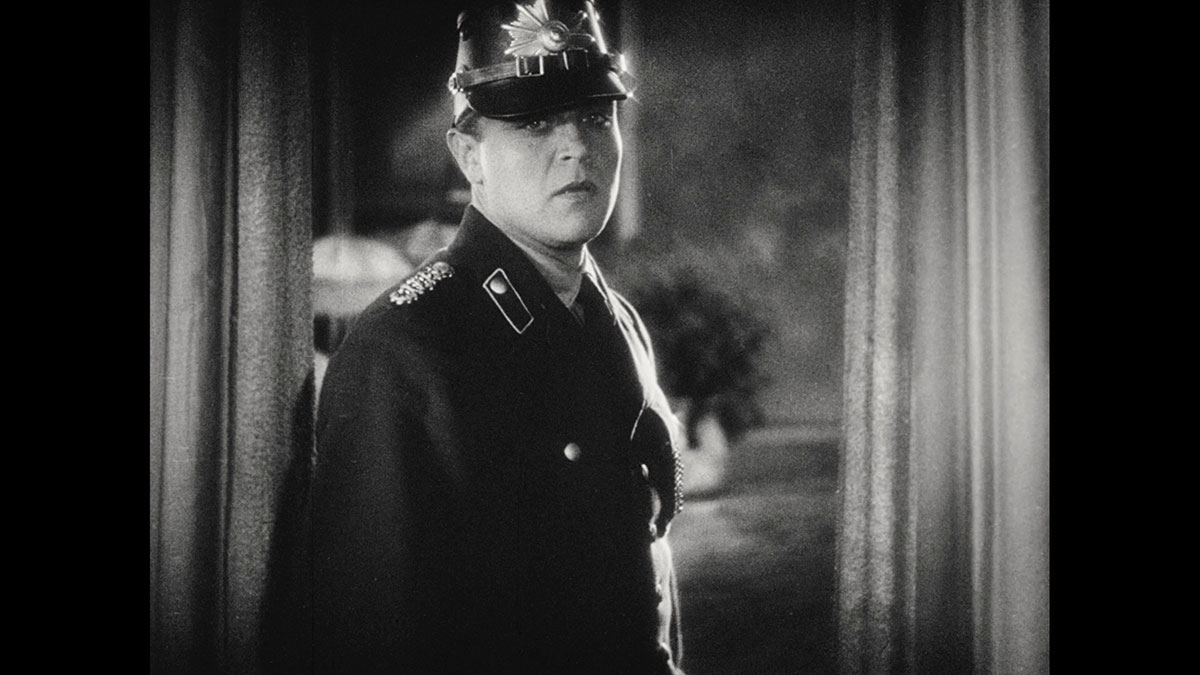
Albert Holk (Gustav Fröhlich, of Metropolis fame), a traffic policeman, meets Else Heller (Betty Amann) as she accused on the street of gem theft. A search reveals the stolen gem and Holk is forced to arrest her. Her pleas for mercy are nearly fruitless until Holk is persuaded to follow her to her apartment, from which she is to be evicted the following day. Or so the story goes . . .
Meanwhile, thieves break into a Parisian bank vault right under the noses of the police and their leader, Langen (Hans Adalbert Schlettow) writes to Else that he is returning to Berlin.
Much as he would like to resist it (in a standout moment in the film when she hands him his hat to leave but won't let go of it) Albert acknowledges he has fallen in love with Else, and he soon proposes marriage. In a fleeting moment Else imagines leaving her criminal life for love but realizes that she cannot escape her past, and she tries to convince Albert he must leave forever by proving that she has lied to him about her poverty. When he turns to go, she leaps at him beg for forgiveness — just as Langen lets himself into her apartment. A room-trashing fight ensues resulting in the murder of Langen.
Albert returns home and confesses to his parents. His father, a police chief sergeant, arrests Albert from his mother’s embrace. Dutifully, Albert follows to the police station. Else soon arrives at the Holk apartment asking for Albert. While giving his statement to police, Albert's mother bursts in with Else, who will testify it was self-defence.
Asphalt is a masterful example of film direction, with Joe May’s self-conscious and, at times, very mobile camera a mute but eloquent narrator. Moving from object to object within a room the camera allows the viewer to quickly assertain a character’s back story. At other times, static close-ups allow the actors to subtly progress from thought to thought in a rich, succinct succession of emotions. The performances of both Amann and Fröhlich, with May’s direction, are the depth of the film, which is surprisingly spare of plot.
Previously, Asphalt was known to have survived only in an abridged version with English language intertitles. In 1993, Berlin’s Stiftung Deutsche Kinemathek discovered that a print of Asphalt had survived in Moscow’s Gosfilmofond film archive, which appeared to have been struck from the original German negative. The Gosfilmofond print presented a different — and what appeared to be the original — continuity along with German intertitles that did not appear in any form in any other surviving prints.
A new high-resolution digital restoration was conducted by Deutsche Kinemathek-Museum für Film und Fernsehen and the Bundesarchiv-Filmarchiv in 2015.
— Carl Bennett
|
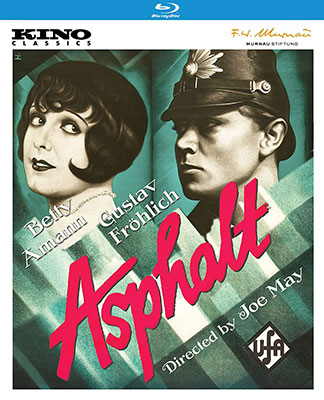 Kino Classics Kino Classics
2023 Blu-ray Disc edition
Asphalt (1929), black & white, 94 minutes, not rated.
Kino Lorber, K26193, UPC 7-38329-26193-1.
One single-sided, single-layered, Region A Blu-ray Disc; 1.33:1 aspect ratio picture in pillarboxed 16:9 (1920 x 1080 pixels) 24 fps progressive scan image encoded in SDR AVC format at 25.4 Mbps average video bit rate; DTS-HD Master Audio 5.1 surround sound encoded at 2.4 Mbps audio bit rate (music), DTS-HD Master Audio 2.0 stereo sound encoded at 1.7 Mbps audio bit rate (music) and Dolby Digital (AC3) 1.0 mono sound encoded at 192 Mbps audio bit rate (commentary); German language intertitles, optional English language subtitles; 10 chapter stops; standard BD keepcase; $29.95.
Release date: 7 March 2023.
Country of origin: USA
Ratings (1-10): video: 8 / audio: 8 / additional content: 7 / overall: 8.
|
This Blu-ray Disc edition of Joe May’s final silent film has been mastered from a 2K digital restoration of the film conducted by Deutsche Kinemathek-Museum für Film und Fernsehen and the Bundesarchiv-Filmarchiv, controlled by the Friedrich-Wilhelm-Murnau-Stiftung. Directly, the difference in visual quality over previous home video editions are the additional details in the picture, which is apparent from the main title onward. It is not the visual quality of a camera negative (and none is known to have survived) but is an admirable reproduction of the very-good 35mm source material and cinematographer Günther Rittau’s impressive work can be fully appreciated. Some dust, speckling, scratches and other print flaws remain but it feels as if there are fewer examples to distract us in this digital restoration version.
The film is accompanied by a lively and entertaining orchestral music score by Karl-Ernst Sasse performed by the Brandenburgische Philharmonie Potsdam. We are happy this score has been retained for this edition. The extra clarity of this Blu-ray Disc edition extends to the soundtrack quality that is quite pleasing in optional 5.1 surround sound (for the first time) or in stereo sound.
Supplementary material includes audio commentary by film historian Anthony Slide. His insights are helpful and are delivered with a touch of delicious wryness in his British accent that reminds us more than a little of John Gielgud. (By the way, Anthony, it’s the broken arm of a chair.)
We are pleased to highly recommend this Blu-ray Disc as the best available home video edition of this film. Let there be no question as to whether it would be worth upgrading from DVD, it is most certainly worth doing so.
|
|
This Region A Blu-ray Disc edition is available directly from . . .
|

|
|
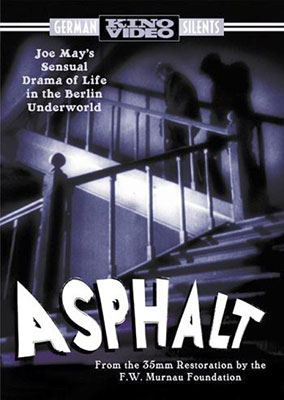 Kino on Video Kino on Video
2006 DVD edition
Asphalt (1929), black & white, 93 minutes, not rated.
Kino International, K464, UPC 7-38329-04642-2.
One single-sided, single-layered, Region 0 NTSC DVD disc; 1.33:1 aspect ratio picture in full-frame 4:3 (720 x 480 pixels) interlaced scan image encoded in SDR MPEG-2 format at 6.0 Mbps average video bit rate (capable of progressive scan upscaling to 60 fps); Dolby Digital (AC3) 2.0 stereo sound encoded at 192 Kbps audio bit rate; English language intertitles, no subtitles; 12 chapter stops; standard DVD keepcase; $29.95.
Release date: 18 July 2006.
Country of origin: USA
Ratings (1-10): video: 7 / audio: 8 / additional content: 0 / overall: 7.
|

This DVD edition of Joe May’s final silent film has been mastered from a restored print controlled by the Friedrich-Wilhelm-Murnau-Stiftung. The natural-speed video transfer allows the romance to unfold at an appropriate pace. The source material still has a typical amount of dust, a more than moderate amount of speckling, emulsion chipping and scuffing, schmutz, momentary emulsion scrapes, exposure fluctuations, timing marks and other flaws. Still, the viewing experience is very-good on upscaling HD systems.
The film is accompanied by a highly-entertaining orchestral music score by Karl-Ernst Sasse performed by the Brandenburgische Philharmonie Potsdam.
We recommend this as the best DVD home video edition for its smoother picture with less pronounced film grain than the Eureka edition below and there being no interlacing conversion issues.
|
|
This Region 0 NTSC DVD edition is available directly from . . .
|
|
|
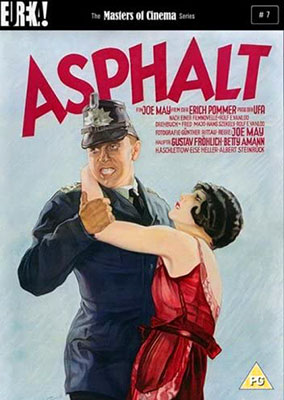 Eureka Entertainment Eureka Entertainment
2005 DVD edition
Asphalt (1929), black & white, 90 minutes, BBFC Classification PG.
Eureka Entertainment,
EKA40088 (MoC 7), UPC 5-060000-400885.
One single-sided, single-layered, Region 2 NTSC DVD disc; 1.33:1 aspect ratio picture in full-frame 4:3 (720 x 576 pixels) interlaced scan image encoded in SDR MPEG-2 format at 7.0 Mbps average video bit rate (capable of progressive scan upscaling to 50 fps); Dolby Digital (AC3) 2.0 stereo sound encoded at 448 Kbps audio bit rate; German language intertitles, optional English language subtitles; 12 chapter stops; standard DVD keepcase; £19.99.
Release date: 18 April 2005.
Country of origin: England
Ratings (1-10): video: 7 / audio: 8 / additional content: 7 / overall: 7.
|
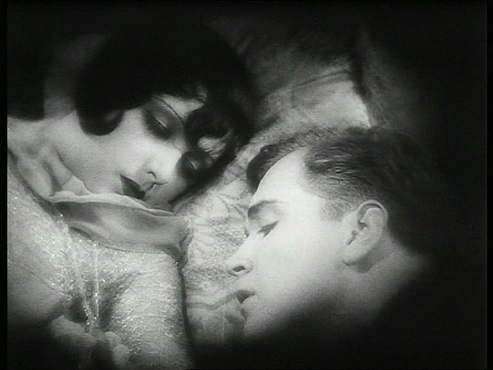
This first DVD edition of Joe May’s last silent film features a video transfer from restored materials, sourced chiefly if not solely from the Gosfilmofond 35mm positive, that include the original German intertitles. The quality of the source material varies from shot to shot, with some excellent footage paired with other that has a mildly-pronounced film grain. HD systems may have a problem with fully converting the interlaced picture into a smoother progressive scan, as some interlaced comb effects are still visible throughout the film.
The film is accompanied by a highly-entertaining new orchestral music score by Karl-Ernst Sasse performed by the Brandenburgische Philharmonie Potsdam.
The disc features optional English language subtitles; a stills gallery (9 images); and a 16-page color booklet with a new essay by film historian R. Dixon Smith.
This is our recommend European DVD home video edition of the film. North American collectors will need a region-free PAL DVD player capable of outputting an NTSC-compatible signal to view this edition.
|
This Region 2 PAL DVD edition has been discontinued
and is . . .
|

|
|
|
Other silent era JOE MAY films available on home video.
Other GERMAN FILMS of the silent era available on home video.
|
|

LINKS IN THIS COLUMN
MAY TAKE YOU TO
EXTERNAL WEBSITES
•




•
|