Silent Era Home Page > Home Video > Foolish Wives

Reviews of silent film releases on home video.
Copyright © 1999-2024 by Carl Bennett
and the Silent Era Company.
All Rights Reserved. |
|
Foolish Wives
(1922)
|
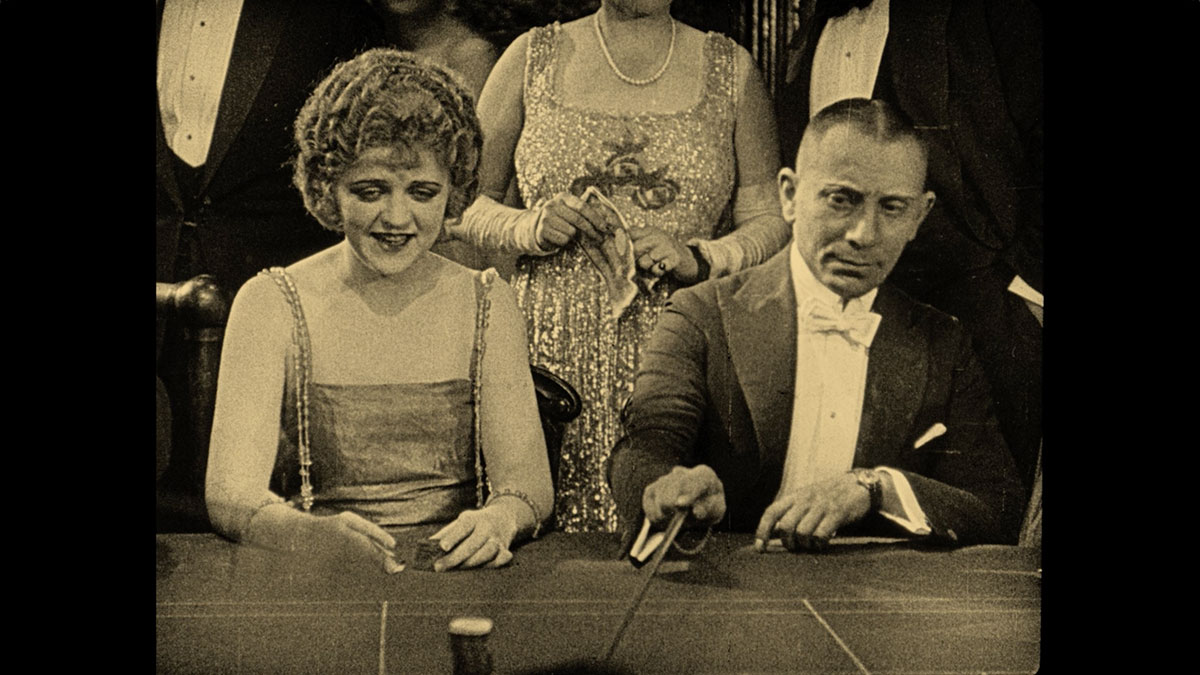
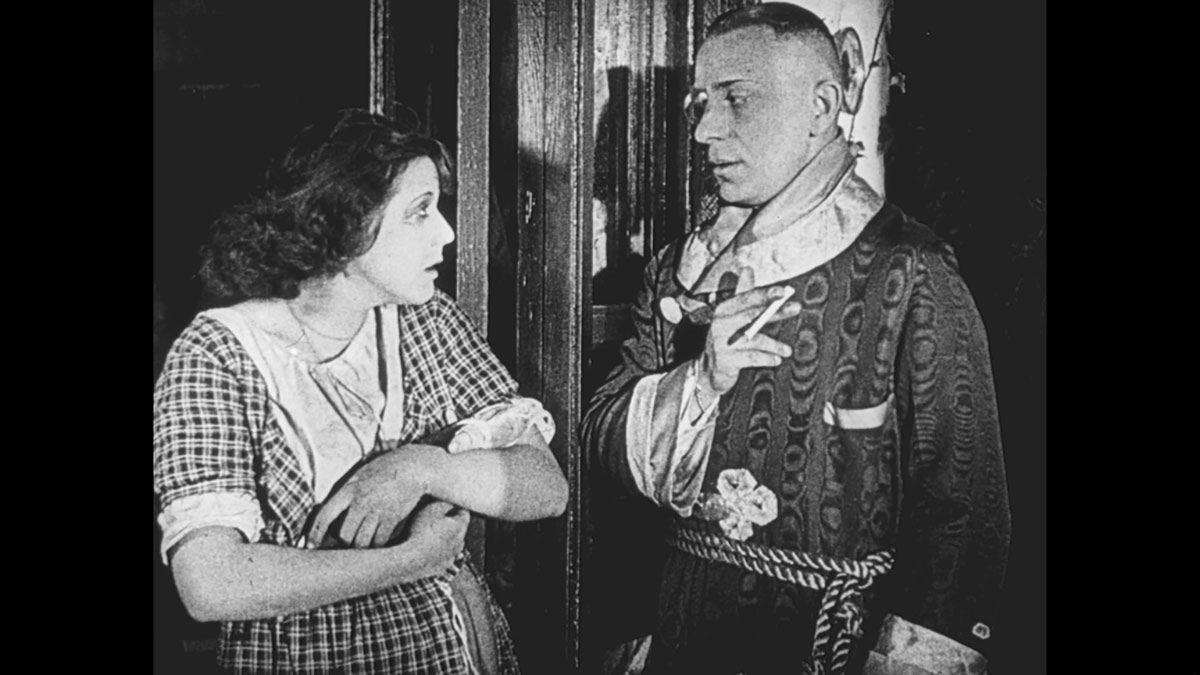
This story of confidence game criminals in Monte Carlo, set to prey on the rich and naïve, gives plenty of opportunity for director Erich von Stroheim to explore his pet themes of European decadence and sex.
We follow the tale of the ‘Count’ Karamzin with a distanced fascination, not unlike watching a dissection with churning repulsion and morbid attraction. Karamzin snakes his way into the lives of an American envoy and his young wife, intent on seduction and theft. Karamzin’s monomanical intent is so focused he is only deflected by the watching eyes of others, and fortune protects Mrs. Hughes from his inveigling ways long enough for Karamzin to receive his just desserts. The final fate of Karamzin is as satisfying (if not abrupt) to modern audiences as it must have been for silent era audiences who came to know Stroheim as the Man You Love to Hate.
For his third film Foolish Wives, von Stroheim shot 320 reels of negative, from July 1920 through June 1921. Production costs exceeded $1 million. Stroheim’s first cut of the film ran to 32 reels. Universal had the film cut in half, to 16 reels, in December 1921. The film premiered in New York at 14 reels in January 1922, and for the film’s general release, it was trimmed further to ten reels.
The film was rereleased in 1928 at seven reels with a synchronized music track. According to DVD producer David Shepard, the studio rearranged the continuity, changing character names, and retitled its even more stripped-down story. It is this 1928 reissue version that has survived.
Also surviving is an original 35mm print struck from the alternate European negative, an Italian print that was also edited to seven reels. In this print, more of the original continuity survived but many of the shots had been shortened, some to a length of only four or five frames. Also characteristic of the ‘foreign’ negatives was the use of alternate takes from those used in the domestic negative, composed of alternate takes from the main camera or takes from a second camera slightly off position from the main camera taking the same performance.
Working on behalf of the American Film Institute in the early 1970s, professor Arthur Lenning utilized the surviving footage in these two truncated versions to attempt to reconstruct an approximation of the general release version of 1922. Lennig employed Universal’s original editing continuities and surviving censorship records to aid the decision-making processes required of this type of reconstruction. The resulting Lennig composite was necessarily a hybrid of best and secondary footage. Some of the shorter shots from the Italian print were so brief that surviving frames were printed two-to-one or three-to-one to extend the shot’s duration long enough for viewers to get some sense of the intended effect. The reconstruction doesn’t accurately represent Stroheim’s intended version but the included footage is all we have left of some portions of Foolish Wives.
In May 2022, a new 4K digital reconstruction of the film undertaken by the San Francisco Silent Film Festival and the Museum of Modern Art premiered celebrating the film’s 100th anniversary. The restoration primarily utilized two source prints for the reconstruction: a color-tinted 35mm nitrate print prepared from the export negative for the Italian release version as held by the Film di Fondazione Cineteca Italiana and a black & white 35mm print of a reedited and retitled version prepared by Universal Pictures Corporation in 1928 (which remained unreleased) held by the Museum of Modern Art. The principal reference materials on which the reconstruction is based is an eight-reel continuity script prepared by the Swedish National Board of Censors in 1922, a 1923 French novelization of the film, cue notes in Sigmund Romberg’s original music score, with additional information from newspaper and film industry publications.
In 2008, the film was listed in the National Film Registry of the Library of Congress’ National Film Preservation Board.
— Carl Bennett
|
 Flicker Alley Flicker Alley
2023 Blu-ray Disc / DVD edition
Foolish Wives> (1922), black & white, color-tinted black & white, and color-tinted and color-toned black & white, 147 minutes, not rated.
Flicker Alley, FA0082, UPC 6-17311-68829-4.
One single-sided, dual-layered, Regions ABC Blu-ray Disc; 1.33:1 aspect ratio picture in pillarboxed 16:9 (1920 x 1080 pixels) 24 fps progressive scan image encoded in SDR AVC format at ? Mbps average video bit rate; DTS-HD Master Audio 2.0 stereo sound encoded at 1.4 Mbps average audio bit rate; English language intertitles, optional Spanish, French, Italian, German and Galician language subtitles; 16 chapter stops; and one single-sided, dual-layered, Region 0 NTSC DVD disc; 1.33:1 aspect ratio picture in full-frame 4:3 (720 x 480 pixels) interlaced scan image encoded in SDR MPEG-2 format at 5.0 Mbps average video bit rate (capable of progressive scan upscaling to 60 fps); Dolby Digital (AC3) 2.0 stereo sound encoded at 192 Kbps audio bit rate; English language intertitles, optional Spanish, French, Italian, German and Galician language subtitles; 16 chapter stops; 24-page insert booklet; standard two-disc BD keepcase; $39.95.
Release date: 27 June 2023.
Country of origin: USA
Ratings (1-10): video: 8 / audio: 9 / additional content: 9 / overall: 9.
|
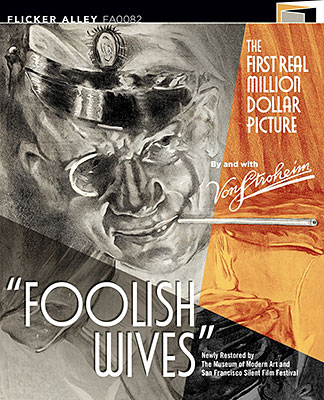
This dual format edition of Foolish Wives has been mastered from the 4K reconstruction conducted by the San Francisco Silent Film Festival and the Museum of Modern Art that utilized the original continuity to combine surviving original 35mm film elements with digital image restoration and recreation of the original color effects to present the closest possible version of the original film. Originally released at more than 14,000 feet, this reconstruction of the film equals a length of 9766 feet (presumably, now imaged to a new preservation negative). Intertitles have entirely been reset for the reconstruction, based on contemporary reference materials.
The digital restoration work is quite admirable. The picture has been stabilized to remove frame jitters, with the majority of dust, speckling, exposure fluctuations, print wear, film grain, timing marks, and other print flaws removed (or, at least, diminished). As should be expected, the resulting images are not perfect (as, for instance, they might be from a scan of an original camera negative). There are at times residual traces of print wear, scratches, exposure fluctuations, film grain, splices and other print flaws that have been diminished. It is quite clear that the restoration artists have chosen to be restrained and conservative in their clean-up efforts. Compared to the image condition of footage from the Arthur Lenning/AFI photochemical reconstruction, the results here are a vast improvement with far fewer flaws to distract modern viewers from the film’s narrative. Depending on the survival state of the source materials, some footage is presented in a very-good to excellent image.
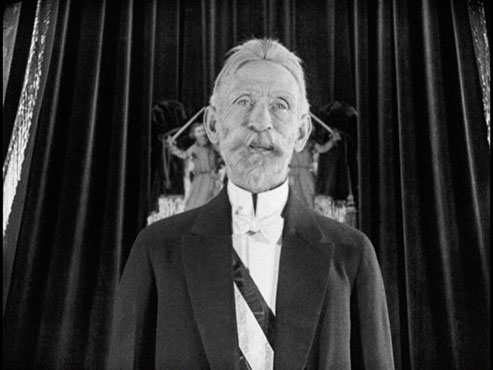
The DVD edition looks nearly as good as the Blu-ray Disc. The choice of viewing disc will depend on the capabilities of your player and your monitor. On upscaling HD systems, the difference between Blu-ray Disc and DVD may be the viewer’s preference for as much sharpness as can be seen (BD) or for a slightly smoother picture (DVD).
The film is accompanied by an orchestral score composed and conducted by Timothy Brock and performed by Real Filharmonía de Galicia. The music is an excellent accompaniment to this restoration; always pleasant, entertaining and appropriate to the film’s narrative.
Supplementary material includes “Filming Foolish Wives,” a color-tinted and color-toned excerpt from Screen Snapshots, Second Series, Number 10 (1922) (2 minutes); “Restoring Foolish Wives,” a detailed behind-the-scenes look at the restoration with film restorer Robert Byrne (14 minutes); “Erich von Stroheim and Hollywood’s First Million-Dollar Picture,” a short documentary on the background of Foolish Wives, presented by Museum of Modern Art film curator Dave Kehr (15 minutes); “The Waves and the Merry-Go-Round: On Location with Erich von Stroheim,” a short documentary presented by cultural historian Brad Rosenstein (38 minutes); a side-by-side source material comparison (4 minutes); a before and after, side-by-side demonstration of the film’s restoration (3 minutes); a photo gallery of more than 100 production and promotional stills and press materials; and a 24-page inset booklet with the essay “Searching for Foolish Wives: The Decades-Long Effort to Reconstruct Erich von Stroheim’s Masterpiece” by James Layton; writing excerpts on Foolish Wives by film historian David Thompson; notes on the Timothy Brock music score; and production stills and promotional materials.
We do not issue annual awards but, were it so, this dual-format set would be our choice for the best home video release of 2023. This is our unreserved recommendation as the best home video edition of the film that is available. Prepare to spend hours with the maestro and his advocates.
|
|
USA: Click the logomark to purchase this Regions ABC Blu-ray Disc / Region 0 DVD edition from Amazon.com. Support Silent Era.
|

|
|
|
Canada: Click the logomark to purchase this Regions ABC Blu-ray Disc / Region 0 DVD edition from Amazon.ca. Support Silent Era.
|

|
|
|
United Kingdom: Click the logomark to purchase this Regions ABC Blu-ray Disc / Region 0 DVD edition from Amazon.co.uk.
|

|
|
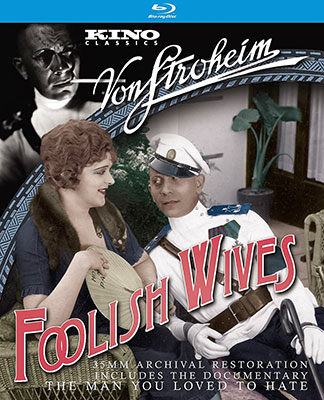 Kino Classics Kino Classics
2013 Blu-ray Disc edition
Foolish Wives (1922), black & white, 143 minutes, not rated, with The Man You Loved to Hate (1979), color and black & white, 90 minutes, not rated.
Kino Lorber, K1166, UPC 7-38329-11662-0.
One single-sided, dual-layered, Region A Blu-ray Disc; 1.33:1 aspect ratio picture in pillarboxed 16:9 (1920 x 1080 pixels) 24 fps progressive scan image encoded in SDR AVC format at 26.6 Mbps average video bit rate; LPCM 2.0 stereo sound encoded at 1.5 Mbps audio bit rate; English language intertitles, no foreign language subtitles; 15 chapter stops; standard BD keepcase; $34.95.
Release date: 30 July 2013.
Country of origin: USA
Ratings (1-10): video: 7 / audio: 7 / additional content: 7 / overall: 7.
|
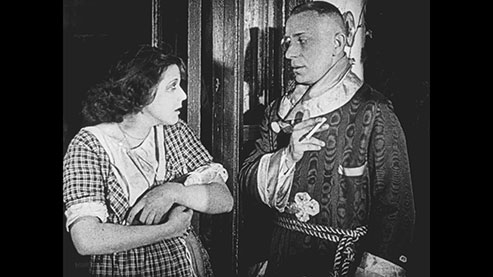
This Blu-ray Disc edition features a better Foolish Wives home video edition than any of the DVD editions reviewed below. This Kino edition (as with its DVD companion edition produced a decade earlier) has been prepared from the American Film Institute’s 1972 restoration of Foolish Wives.
The shortcomings of the AFI’s restoration are more apparent in high-definition. Both the condition of the surviving materials and the once state-of-the-art photochemical restoration technology point up that the sources for the restoration were less than perfect, as the film has survived only in a rough form that is sometimes moderately grainy, scuffed, scratched, jumpy, speckled and with light emulsion damage. Film grain is more pronounced in some of the footage as it is rendered in higher detail. No digital image stabilization has been performed for this edition.
While a viewer can be distracted by the print damage, the image details in the HD transfer are even sharper now with a reasonably full range of greytones that probably well-represent those remaining in the surviving material. Shadow details in the restoration print are a bit plugged-up in the darker ranges. But, image definition is now noticeably sharper in surprising places: the lace of Maude George’s morning dress, the architectural details of the Monte Carlo set, the intricacies of a roulette table, etc. While the changes in image quality of the surviving fragments of footage are now more apparent in high definition, it must be said that we enjoy viewing the extra image details afforded by this Blu-ray Disc edition.
The edition is again graced by the 1922 Sigmund Romberg music score, which was expertly performed on piano by Rodney Sauer in 2003.
Also available on the disc is the 1979 documentary The Man You Loved to Hate, written by historian Richard Koszarski and directed by Patrick Montgomery. This presentation benefits greatly from its new high-definition video transfer.
The supplementary materials include an even-handed and informative audio commentary by Stroheim biographer Richard Koszarski, a still photo and promotional materials gallery that benefits from HD scans, documentation on New York Censor Board cuts on the 14-reel version of Foolish Wives, and audio selections featuring interviews with Valerie Germonprez von Stronheim and Paul Kohner. The BD edition does not include the notes on the film by Erich von Stroheim or the notes on the music score that were included in the Kino DVD edition.
One may be tempted to ask . . . with the less than perfect condition of the surviving print material, is this Blu-ray Disc edition a significant enough improvement for a collector’s upgrade. We must say that, with a handful of home video editions based on the same materials, this is as good as the Lenning restoration will look. We believe that with the rough survival state of the film presented herein now requires evaluation of the reconstruction version of Foolish Wives to be released by Flicker Alley (noted above) before continuing to recommend this Kino Blu-ray Disc as the best home video edition.
|
|
USA: Click the logomark to purchase this Region 0 Blu-ray Disc edition from Amazon.com. Your purchase supports Silent Era.
|
|
|
|
Canada: Click the logomark to purchase this Region 0 Blu-ray Disc edition from Amazon.ca. Your purchase supports Silent Era.
|
|
|
|
United Kingdom: Click the logomark to purchase this Region 0 Blu-ray Disc edition from Amazon.co.uk. Support Silent Era.
|
|
|
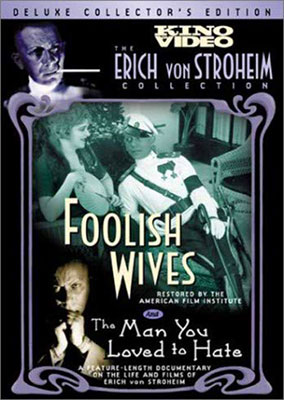 Kino on Video Kino on Video
2003 DVD edition
Foolish Wives (1922), color-toned black & white and black & white, 143 minutes, not rated,
with The Man You Loved to Hate (1979), color and black & white, 78 minutes, not rated.
Kino International, K247, UPC 7-38329-02472-7.
One single-sided, dual-layered, Region 0 NTSC DVD disc; 1.33:1 aspect ratio picture in full-frame 4:3 (720 x 480 pixels) interlaced scan image encoded in SDR MPEG-2 format at 4.5 Mbps average video bit rate (capable of progressive scan upscaling to 60 fps); Dolby Digital (AC3) 2.0 stereo sound encoded at 192 Kbps audio bit rate; English language intertitles, no foreign language subtitles; 20 chapter stops; standard DVD keepcase; $29.95.
Release date: 10 June 2003.
Country of origin: USA
Ratings (1-10): video: 6 / audio: 7 / additional content: 7 / overall: 7.
|
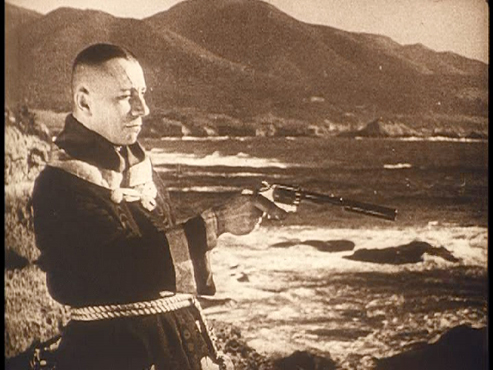
Kino International has produced a better-looking Foolish Wives DVD edition than the 2000 Image edition reviewed below. This Kino edition has been prepared from the American Film Institute’s restoration of Foolish Wives — the same materials as the Image edition.
Comparing this DVD edition to Kino’s 1989 laserdisc, we note that a new video transfer has been made which is slower in projection speed, closer to a natural pacing. The full-frame transfer is framed a little tighter than the laserdisc, which was off-center to the left (but not notable on most televisions), but not quite as tight as the Image DVD edition. However, some of the intertitles will be cropped at left and right on some televisions. A bit of care could have been taken to electronically reduce the size of problem intertitles to ensure readability.
Image details in the transfer are sharper now and the full range of greytones are open and well defined. The DVD, which is mostly presented in color-tones, is slightly less contrasty than the laserdisc, which was black & white. The sources for the AFI restoration print were less than perfect, as the film has survived only in a rough form that is sometimes moderately grainy, scuffed, scratched, jumpy, speckled and with light emulsion damage. There are fewer signs of print dust present in this transfer than in the Image transfer.
In reevaluating the disc on high-definition equipment that upscales the DVD’s standard-definition interlaced NTSC video encoding to a high-definition 1080-line progressive-scan signal, the disc renders a very-good image that doesn’t quite approach a filmlike feel, due largely to the moderately-low video bit rate of the MPEG-2 encoding that creates a hatch-pattern of image compression details that is discernable to the sharp-eyed. The compression artifacts are the by-product of the packaging of a long feature with another feature-length program on one (albeit dual-layered) disc. For this reason, we have lowered our original rating of the video quality, and hope that the film is one day released at a higher bit rate on a disc by itself to improve image quality.
The Sigmund Romberg music score from 1922 is performed on piano by Rodney Sauer and supersedes the Steve Sterner 1989 laserdisc score quite well. Both piano scores convey the drama of the film, but the sonic quality of the Sauer performance is reproduced better here.
Also available on the disc is the 1979 documentary The Man You Loved to Hate, written by historian Richard Koszarski and directed by Patrick Montgomery.
The supplementary materials include an even-handed and informative audio commentary by Stroheim biographer Richard Koszarski, outtake footage, a still photo and promotional materials gallery, notes on the film by Erich von Stroheim, documentation on New York Censor Board cuts, and audio selections featuring Valerie Germonprez von Stronheim and Paul Kohner.
Despite a miniscule amount of differences in the footage represented in the Image edition (as noted below), the Kino edition features superior image quality of a sometimes rough restoration print, without the inferior editing differences of the Image disc. Owners of the Kino laserdisc can seriously consider upgrading their collection to this new edition, with its slower, natural-paced transfer. We recommend this Kino edition as the best DVD home video edition of Foolish Wives.
|
|
USA: Click the logomark to purchase this Region 0 NTSC DVD edition from Amazon.com. Your purchase supports Silent Era.
|
|
|
|
Canada: Click the logomark to purchase this Region 0 NTSC DVD edition from Amazon.ca. Your purchase supports Silent Era.
|
|
|
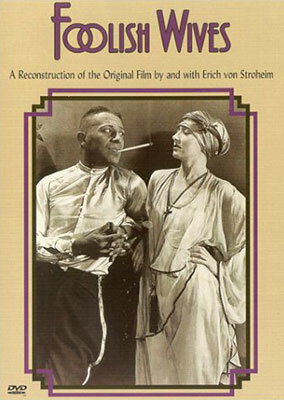 Film Preservation Associates Film Preservation Associates
2000 DVD edition
Foolish Wives (1922), color-toned black & white, 141 minutes, not rated.
Film Preservation Associates, distributed by Image Entertainment, ID9414DSDVD, UPC 0-14381-94142-5.
One single-sided, single-layered, Region 0 NTSC DVD disc; 1.33:1 aspect ratio picture in full-frame 4:3 (720 x 480 pixels) interlaced scan image encoded in SDR MPEG-2 format at 5.0 Mbps average video bit rate (capable of progressive scan upscaling to 60 fps); Dolby Digital (AC3) 2.0 stereo sound encoded at 192 Kbps audio bit rate; English language intertitles, no foreign language subtitles; 21 chapter stops; snapper DVD case (reissued in standard DVD keepcase); $29.99.
Release date: 19 September 2000.
Country of origin: USA
Ratings (1-10): video: 4 / audio: 7 / additional content: 0 / overall: 5.
|
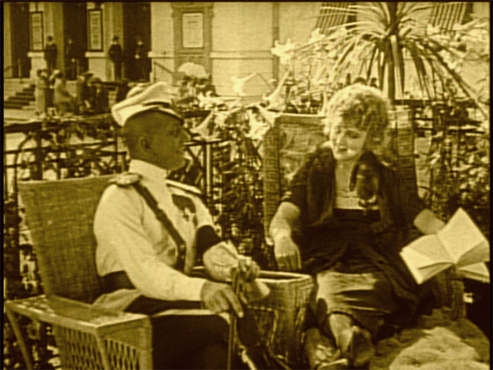
The previous best home video ediion of Foolish Wives was released by Kino International on laserdisc and VHS videotape in 1989. That Kino edition, as is this edition produced by David Shepard of Film Preservation Associates, utilized the Lennig reconstruction as the source material for the video transfer. However, the video transfer for the Shepard edition is very tightly framed, with a substantial amount of all edges of the picture cropped out, the bottom most of all. When Mrs. Hughes bumps into the armless soldier, you can hardly see that there is no hand protruding from his right sleeve. For one reel, more of the top of the frame is cropped out and more of the bottom of the frame is seen. Also, much of the end of Shepard’s edition’s transfer is dark.
The restoration is listed in the closing credits as produced by Blackhawk Films and the American Film Institute in 1973, with the project produced by David Shepard and edited by Arthur Lennig. I suspect that these credits are a bit of historical revisionism. But also listed is video editing by Bret Hampton, which implies that additional editing has been done for this home video edition. Our inspection of the DVD appears to validate the implication.
Right away something is awry with the Image DVD. The opening shot of the roulette wheel, its superimposed first intertitle about Monte Carlo, and the subsequent dissolve to a scenic shot of Monte Carlo are all missing from the Shepard edition. This led us to a detailed inspection of both the Kino and Shepard editions.
The first footage in the Shepard edition not present in the older Kino edition is within the scene where Count Karamzin is first introduced to Mrs. Hughes. As it turns out, the extra footage seen here is something of a sleight of hand. The footage from 28:26 through 28:30 is the same footage as repeated at 29:56 through 30:00.
A problematically horizonally-long intertitle at 30:34, which is cropped off on left and right in the Kino edition, has been reset to ensure readability on all televisions. However, the book page beginning at 31:39 in the Shepard edition is so cropped at the edges of the image, a viewer cannot make sense of the book passage that Stroheim wants us to read.
A different cloud shot begins at 49:11 in the Shepard edition, followed by the same clouds and lightning shot seen in the Kino edition. We question whether this footage was part of Stroheim’s film or was lifted from another film to stretch the visual establishment of the cloudy sky before a bolt of lightning is shown.
The Shepard edition is missing a close-up of the laughing Mother Garoupe that is present in the Kino edition, instead substituting another close-up beginning at 56:18 that is repeated in its proper place beginning at 57:06.
The shot of Mr. Hughes waking up, beginning at 1:13:04, is a close-up in the Shepard edition as opposed to the different take medium shot, with a dark lamp in the foreground, that is in the Kino edition.
At 1:17:35 the Shepard edition displays an intertitle, “Later that afternoon -- a visit to Ventucci,” whereas the Kino edition features the intertitle, “A section in Monte Carlo where the losers in Life’s game abide,” before both showing the same footage of Karamzin walking up the steps to Ventucci’s home. We suspect that the double hyphen instead of the contemporary longer dash indicates Shepard’s insertion of his own intertitle here. Also, the Kino edition is missing the iris-in beginning of the following shot that is in the Shepard edition.
The close-up of Karamzin’s maid at 1:24:12 pauses for a few frames then jumps ahead to edit out a small number of frames of emulsion flaws in the source print that are seen in the Kino edition.
In the Shepard edition, the footage of Karamzin taking the maid’s money repeats beginning at 1:30:38, with different framing, what has already been shown beginning at 1:30:09, but doesn’t complete the shot as seen in the Kino edition. This appears to be a digital editing error.
In both editions alternate takes repeat, one after another, of a party of four, including Karazin and Hughes, moving into the frame from the left beginning at 1:37:32. This is an editing oversight of Lennig’s, with possibly one shot being from the domestic negative and the other from the foreign negative.
The intertitle at 1:39:21 “Your new system, Count?” is different from the corresponding intertitle “A new system to break the bank, Count?” in the Kino version.
The confrontation between Hughes and Karamzin begins a series of shots, from 2:12:59 through 2:13:17, that differ in the chosen takes of shots and the inclusion of shots not in the Kino edition's corresponding sequence. The Shepard edition’s five-shot sequence features better continuity than the corresponding three-shot sequence in the Kino edition.
At 2:16:14 the shot of Karamzin shushing Ventucci’s daughter is repeated, from its first appearance at 2:16:12, in its extended length.
The Shepard edition features the film’s original closing title card.
The musical setting of the Shepard edition is performed on piano by Philip Carli and conveys well the mood of the film.
Ultimately, the video transfer of the Kino DVD edition is undeniably sharper than this Shepard DVD transfer. We find that the miniscule amount of additional footage on this DVD edition hardly makes up for its shortcomings. We do not recommend this Image edition.
|
|
USA: Click the logomark to purchase this Region 1 NTSC DVD edition from Amazon.com. Your purchase supports Silent Era.
|
|
|
|
Canada: Click the logomark to purchase this Region 1 NTSC DVD edition from Amazon.ca. Your purchase supports Silent Era.
|
|
|
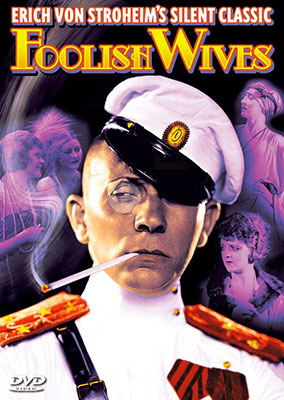 Alpha Video Alpha Video
2004 DVD edition
Foolish Wives (1922), black & white, 107 minutes, not rated.
Alpha Home Entertainment, distributed by Oldies.com,
ALP 4316D, UPC 0-89218-43169-1.
One single-sided, single-layered, Region 0 NTSC DVD-R disc; 1.33:1 aspect ratio picture in full-frame 4:3 (720 x 480 pixels) interlaced scan image encoded in SDR MPEG-2 format at 4.0 Mbps average video bit rate (capable of progressive scan upscaling to 60 fps); Dolby Digital (AC3) 2.0 stereo sound encoded at 192 Kbps audio bit rate; English language intertitles, no foreign language subtitles; 6 chapter stops; standard DVD keepcase; $6.98 (raised to $8.98).
Release date: 27 January 2004.
Country of origin: USA
Ratings (1-10): video: 4 / audio: 4 / additional content: 0 / overall: 4.
|
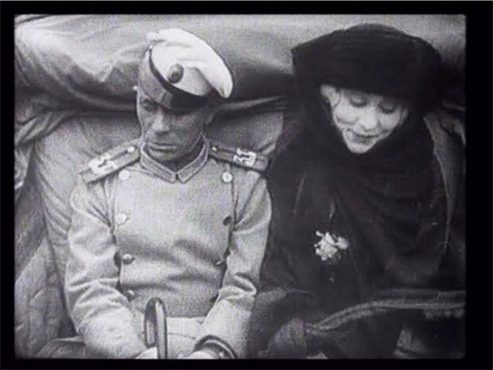
This budget DVD edition has been transfered at sound speed from 16mm reduction print AFI/Lennig materials. Depending on the survival state of each shot, there can be a substantial amount of dust, speckling, exposure flickers, timing marks, emulsion chipping, and other print flaws. The disc video information has been substantially compressed — as is the case with all budget discs — and renders a slightly coarser picture than the old laserdisc edition.
The film is accompanied by a soundtrack of compiled preexisting orchestral music recordings that isn’t bad, but isn’t always appropriate to the film’s action.
Overall, this isn’t a bad budget disc, but we don’t recommend it due to its faster transfer and generic music. With all of the better editions noted above, don’t bother with this one.
|
|
USA: Click the logomark to purchase this Region 0 NTSC DVD-R edition from Amazon.com. Your purchase supports Silent Era.
|
|
|
|
Canada: Click the logomark to purchase this Region 0 NTSC DVD-R edition from Amazon.ca. Your purchase supports Silent Era.
|
|
|
|
United Kingdom: Click the logomark to purchase this Region 0 NTSC DVD-R edition from Amazon.co.uk. Support Silent Era.
|
|
|
|
Other silent era ERICH VON STROHEIM films available on home video.
|
|
Erich von Stroheim filmography in The Progressive Silent Film List
|
|
|

LINKS IN THIS COLUMN
WILL TAKE YOU TO
EXTERNAL WEBSITES
•
SUPPORT SILENT ERA
USING THESE LINKS
WHEN SHOPPING AT
AMAZON



•













































•
|