Reviews of silent film releases on home video.
Copyright © 1999-2024 by Carl Bennett
and the Silent Era Company.
All Rights Reserved. |
|
The
Dixie Flyer
(1926)
|
This railroad drama from low-budget studio Trem Carr Productions is light on originality, but should be a delight for fans of railroad pictures. There are enough shots of train engines, cars, tracks, depots, handcars, and train chases to satisfy railroad enthusiasts.
S. & W. Railroad president Rapley (Ferdinand Munier) is risking his position to build the Black River Spur stretch of the railroad line, meanwhile vice-president Bedford (John Elliot) and his smarmy son (A. Richard Rowlands) are doing what they can to delay completion of the line.
Resourceful daughter Rose Rapley (Eva Novak) sees the deceit her father cannot and anonymously travels to the construction site to investigate. Construction superintendent ‘Sunrise’ Smith (Cullen Landis) is trying to quell threats of strike while keeping the project on schedule.
When a plot is hatched to unhitch the president’s railroad car from the Dixie Flyer at the top of a steep grade, Smith and Rose discover the scheme and attempt to stop the crime.
To save film production costs, the 1337 engine becomes the 337 engine through some unconvincing blacking out of numbers to represent a third train. Famed cinematographer Joseph Walker also helped shoot this action picture.
— Carl Bennett
|
 Golden Age Publishing Golden Age Publishing
2003 DVD edition
The Dixie Flyer (1926), black & white and color-toned, 71 minutes, not rated.
Golden Age Publishing, no catalog number,
no UPC number, ISBN 1-59090-200-9.
One single-sided, single-layered, Region 0 NTSC DVD-R disc; 1.33:1 aspect ratio picture in full-frame 4:3 (720 x 480 pixels) interlaced scan image encoded in SDR MPEG-2 format at 4.5 Mbps average video bit rate (capable of progressive scan upscaling to 60 fps); no audio tracks; English language intertitles, no foreign language subtitles; no chapter stops; slimline jewel CD case; $14.95 (reduced to $9.99).
Release date: 2003.
Country of origin: USA
Ratings (1-10): video: 6 / audio: 0 / additional content: 0 / overall: 6.
|
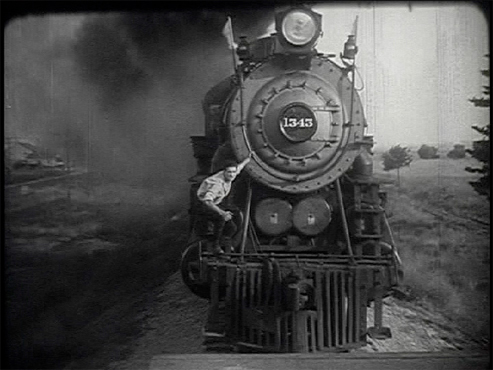
The 35mm print utilized for this DVD-R edition appears to be complete but is missing its main titles and ending titles, except that the presentation starts with a freeze-frame of the cast list. The heavily-worn print could have benefitted from a wet-gate video transfer to minimize the fine vertical scratches to the clear stock layer of the print that show up in the highlights of the picture. There is also a moderate amount of dust, emulsion scratches and chipping, print-processing defects, frame jumps, punch holes, and a few splices in the source print.
The video transfer is full frame and framed tight enough that the cast list and some of the letter inset shots will be cropped on some televisions, but most of the intertitles should remain readable. There is a very slight exposure flickering in the transfer on occasion, and from time to time either the left or the right side of the picture is slightly out of focus — the result of a nonprofessional video transfer. Yet, depite these shortcomings, the presentation remains of sufficient quality to be watchable without much viewer distraction. Often, the image details of the 35mm source print are well-reproduced, making this transfer better than other small home video company transfers from 16mm reduction prints.
The film is presented without a soundtrack, so viewers may need to put appropriate music on their stereo system to accompany the film while it is running.
Ultimately, the disc is worth the expense of its modest cost since this is likely to be the only home video edition of The Dixie Flyer available to silent film collectors.
|
|
GOLDEN AGE PUBLISHING has discontinued publishing home video products and this DVD-R edition is . . .
|

|
|
|
Other RAILROAD FILMS of the silent era available on home video.
|